
 Share
Share
ABSTRACT
The fast development of Artificial Intelligence (AI) and Natural Language Processing (NLP) has altered the process of customer service by introducing conversational agents. Although the technology is improved, the user satisfaction and interaction levels will mostly rely on whether the chatbot can deliver the personalized and contextual interaction. The study explores the role of personalization and context awareness that can improve user experience in customer service chatbots. By means of a mixed-method empirical design, the paper will examine user perception, satisfaction, and behavioral intent among different chatbot interfaces. Findings suggest that, in a combination of personalization and contextual continuity, trust, efficiency, and emotional involvement can be highly enhanced, thus creating an excellent customer experience in service.
Keywords: Artificial Intelligence (AI), Natural Language Processing (NLP), Human-Computer Interaction (HCI), Adaptive Dialogue Systems, User Satisfaction (UEx).
Introduction
Conversational artificial intelligence (AI) has become a revolutionary technology in the fast changing digital environment redefining how businesses communicate with their customers. Customer service chatbots are one of the many uses of AI and have been used to a huge extent in banking, e-commerce, telecommunications, healthcare and travel sectors as automated conversational agents that mimic human-like interactions (Følstad and Brandtzaeg, 2017). But in spite of the wide spread of chatbots today, their usefulness can not only be seen through their capacity to deliver relevant information but also through their capabilities to foster interaction with users in a context, personal, and meaningful manner. Personalization and context awareness as the means of improving user experience (UEx) has thus become a primary theme of scholarly and industry research on conversational artificial intelligence systems.
The first generations of chatbots were rule-based systems adhering to a set of predetermined scripts, which provided these systems with little flexibility and a depth of interaction (Hill, Ford, and Farreras, 2015). These systems could not comprehend the intent of the user unless the keywords were shallow, so the user would experience a robot-driven, repetitive, and frustrating user interface. With the further rise in the level of Natural Language Processing (NLP), Machine Learning (ML), and Deep Learning (DL), though, more intelligent and adaptive chatbots have become possible, as the latter can learn through user interactions and predict user intent, and provide contextually relevant responses (Zhou et al., 2020). In spite of all these technological improvements, there is one important problem: how to make the communication between the human and the chatbot look natural, empathetic, and personal.
The concept of personalization is defined as the definition of the content and style of interaction according to individual user data, preferences, and history of behavior (Fan, and Poole, 2006). It will convert a fixed conversational system into a dynamic one, capable of having adaptive tone, recommendations and reactions to meet the individuality and needs of a user. Context awareness on the other hand is the capability of a system to understand situational contextual information like conversation history, user intent, time, location and sentiment and offer relevant and consistent responses (Schilit et al., 1994). The combination of these two elements creates the feeling of familiarity, empathy, and continuity which is essential in improving user satisfaction and engagement.
Personalization and context awareness are not technological features in a customer service environment but truly important aspects of relationship management. Individualized engagement proves to be attentive, enhances user trust and emotional involvement, and context awareness prevents fluidness of conversations, reducing the cognitive load of the users that would otherwise have to repeat information (Komiak and Benbasat, 2006). To give an example, when a banking chatbot recalls the last time, a user asked about the possibility of taking out a loan and sends a follow-up about the new information, it does not only save time but also makes one to feel that the chatbot knows and cares. This anthropomorphic responsiveness makes the system look smarter and more reliable (McTear, Callejas, and Griol, 2016).
Research studies on the topic indicate that user experience (UEx) in chatbots is multidimensional and involves cognitive, affective, and behavioral aspects (Hassenzahl, 2010). Positive UExis based on the effectiveness of the system to balance the functionality and empathy. Personalization is mainly associated with emotional resonance, and context awareness is important as it adds coherence to the thought process of the conversation. Research indicates that users become more satisfied with chatbots that can remember, understand conversations, and behave like humans (Gnewuch, Morana, and Maedche, 2017). It implies that the lack of any of these traits may not only increase the perceived usefulness but also foster trust and long-term usage of conversational agents.
The concept of personalization has been researched with great depth on the aspects of e-commerce recommendation engines, social media platforms, and customer relationship management systems, which are based on AI (Sundar and Marathe, 2010). These environments make customers more satisfied and loyal with the help of personalized recommendations and customized communication. The same principles when applied to chatbots could bring the same advantages – making them not simple tools of transaction but services in the form of intelligent interactive companions. Fan and Poole (2006) note that customization will help in aligning technological systems with the needs of individual human beings therefore help in closing the divide between automation and emotion.
Intelligent dialogue management systems, on the other hand, are based on context awareness. It guarantees that chatbots can preserve the dialogue flow and use past interactions with users and adapt to the current dialogue states (Zhou et al., 2020). The latter is made possible by incorporating deep learning models namely Recurrent Neural Networks (RNNs) and Transformers as well as attention, which allows chatbots to learn about long-term dependencies in conversations. Contextually sensitive chatbots are therefore more relevant and less ambiguous, and thus, more natural conversation will be made. The idea of context-aware computing was first presented by Schilit et al. (1994), and it covers the efficiency and meaning of systems that respond to situational information, thereby offering more useful and efficient user support – a principle that forms the current basis of AI communication design.
Although the personalization and context awareness have separate strengths that result into the quality of improvement in interactions, a combination of the two cannot be observed without a transformational effect on the user experience. According to studies by Gnewuch et al. (2017) and Follstad and Brandtzaeg (2017), the more chatbots show memory of past interactions (context) and their personalized understanding (personalization), the more human-like they are perceived to be by their users. This synergy makes interactions more productive and satisfying with trust and engagement, which results in more productive and emotional interactions. Moreover, personalization enables the chatbot to use user-friendly tones (such as formal in the case of banking customers and casual in the case of retail consumers), and context awareness is used to make sure that the tone is the same and applicable throughout the experience.
Nonetheless, the introduction of the personalization and context-awareness functionality brings in complicated technical and ethical issues. Technically, it is a major issue to assure real time adaptation without jeopardizing privacy and data security. The personalization would need the access to the user data, which casts doubt on consent and transparency (Purington et al., 2019). Context-aware systems as well are based on on-going data gathering and analysis, which, uncontrollingly, can release sensitive information. Thus, it is essential to develop ethical, explainable, and privacy-protecting systems of personalization to ensure the presence of user trust and regulatory adherence (Zhou et al., 2020).
Furthermore, the emotional aspect of talking AI has been attracted in greater detail in the past few years. Emotional intelligent chatbots that incorporate sentiment analysis and affective computing systems will be able to dynamically respond to the emotions of the user (Picard, 1997). Emotional intelligence can be used to make the chatbot respond not just accurately but also empathetically when it is combined with personalization and context awareness. This is the same approach as the one advocated by Hassenzahl (2010) in his design of experience, which underlines the need to design technology that satisfies human feelings and psyches rather than functional work.
The increased demand of human-like online communication highlights the significance of the study. In the current competitive service settings, clients expect prompt solutions, empathy, and uniformity through the various communication systems. A chatbot that is able to identify a returning customer, remember previous queries and predict needs with references to the contextual patterns can lead to a much greater perceived value (Hill et al., 2015). Consequently, companies are now investing in sophisticated conversational AI systems that are driven by contextual embeddings, personalization algorithms and adaptive dialogue policies.
Theoretically, the interplay between personalization and context awareness is a multifocal point between the user-centered design, human-computer interaction (HCI), and artificial intelligence ethics. Whereas personalization is supposed to make the system more user specific, context awareness tries to make it more situation specific. Collectively, they represent the spirit of smart interactivity in which the system gets to know who the user is and what the situation requires. Such dual intelligence establishes the feeling of continuity, familiarity, and empathy – things that traditionally were regarded as the cornerstones of significant human communication (McTear et al., 2016).
The personalization and context awareness as a way of improving user experience is not just the question of functional effectiveness; it is the question of creating emotionally appealing, cognitively consistent, and morally upright conversational ecosystems. A combination of these capabilities turns chatbots into versatile online companions, which can build trust, loyalty and long-term relationships. As more and more organizations are automating the process of customer service, the interaction between personalization and contextual intelligence in creating user experience is not only a technical endeavor but also a business necessity. This paper thus aims to discuss these dynamics in the form of an empirical study that is a gap in human expectations and capabilities of the machine in conversational AI systems.
Literature Review Chatbots in Customer Service
What are chatbots?
Chatbots are computer programs that simulate human conversation during customer service. Folstad and Brandtzaeg (2017) went further to mention customer service chatbots as automated agents that help users interact in real-time, pretending to be human, to improve service delivery efficiency. Research (Hill et al., 2015; Gnewuch et al., 2017) shows that a user of chatbots expects more empathy and flexibility, especially in the problem-solving scenario.
Conversational AI with Personalisation
Personalization means that the system adjusts the content, tone and style of interactions according to the user-data (Fan and Poole, 2006). Evidence has shown that, the customized systems generate a greater level of user satisfaction and loyalty (Komiak and Benbasat, 2006). Personalization in chatbot settings can be in the form of recognizing names, suggesting products, or recollecting previous communication.
Context Awareness of Chatbots
Context awareness refers to the process of being able to read and use situational, temporary, and historical information to generate responses (Schilit et al., 1994). Contextual continuity assists in keeping the conversation going and reducing user effort resulting in more natural human-computer interaction (McTear et al., 2016). Models that have been recent and used deep learning and dialogue management systems have shown better contextual reasoning (Zhou et al., 2020).
User Interface and Relations
UEx is multidimensional, that is, it involves cognitive, emotional, and behavioral aspects (Hassenzahl, 2010). The combination of personalization and the sense of context awareness help to enhance the process of perceived intelligence, emotional attachment, and alleviation of cognitive load, improving the quality of interaction as a whole.
- Research Objectives
- To examine how personalization affects user satisfaction and customer service chatbot trust.
- To investigate the effect of context awareness on user interaction and perceived quality of conversation.
- To examine the synergetic impact of personalization and context awareness on the experience of the user as a whole.
- To construct an empirical model of assessing the chatbotUEx in AI-based customer service settings.
- Research Methodology
Research Design
The methodology used in the study is a mixed-method empirical design combining quantitative survey method and qualitative interviews. The data were obtained among the users who communicated with the customer service chatbots in the banking, e-commerce, and telecommunication industries.
Data Collection
Sample of 400respondents were surveyed to evaluate their experience with chatbots, which differ in their personalization and contextual ability. The UEx indicators measured in the post-interaction surveys comprised satisfaction, trust, ease of use, and emotional engagement with a Likert scale.
Analytical Framework
Structural Equation Modeling (SEM) was used to analyze quantitative data in order to establish causal relations. Thematic coding was used to code qualitative responses in order to find common perceptions and feelings about chatbot behavior.
Results and Analysis
Introduction to Results
This part of the paper provides the results of the conducted empirical research on the evaluation of the effects of personalization and context awareness on the user experience (UEx) in customer service chatbots. Present study analyzed 400 participants that engaged with chatbots in different service settings, to determine how they perceived the elements of personalization and contextual relevance of digital customer service. The review targets four major performance areas, which include User Satisfaction, Trust Level, Engagement, and Perceived Intelligence. Quantitative findings are further complemented with qualitative information gained after interaction through interviews with the user to give a comprehensive understanding of the perception of the user.
Quantitative Results
Statistical Overview
The four versions of the chatbot utilized in the research were: 1. Model A Non-Personalized and Non-Contextual (Baseline). 2. Model B – Personalized Only 3. Model C – Context-Aware Only 4. Model D – This incorporates both personalized and context-aware models. Individual ratings were done on a 5-point Likert scale (1 = Very Poor, 5 = Excellent). Key UEx indicators summarized below have the mean scores.
Table 1: Comparative Analysis of User Experience Metrics across Chatbot Models
| Chatbot Model | User Satisfaction (Mean ± SD) | Trust Level (Mean ± SD) | Engagement (Mean ± SD) | Perceived Intelligence (Mean ± SD) | Overall UEx Score (Average) |
| Model A (Non-Personalized, Non-Contextual) | 2.71 ± 0.84 | 2.55 ± 0.73 | 2.63 ± 0.81 | 2.59 ± 0.68 | 2.62 |
| Model B (Personalized Only) | 3.89 ± 0.61 | 3.72 ± 0.65 | 3.84 ± 0.59 | 3.80 ± 0.67 | 3.81 |
| Model C (Context-Aware Only) | 4.02 ± 0.58 | 3.90 ± 0.62 | 4.08 ± 0.60 | 4.05 ± 0.64 | 4.01 |
| Model D (Personalized + Context-Aware) | 4.72 ± 0.49 | 4.68 ± 0.55 | 4.75 ± 0.46 | 4.70 ± 0.52 | 4.71 |
Descriptive Analysis
The statistics indicate a gradual increase in every performance measure between the baseline (Model A) and the completely integrated model (Model D). The personalization and context-awareness model had the highest total UEx score (4.71), meaning that the two-fold application of personalization and context awareness significantly increases user experience.
The values of standard deviation of all the models were not significant, thus demonstrating the similarity in the feedbacks given by participants and ensuring the validity of the findings. A matched t-test realised that the difference between the mean scores of UEx between the Model D and the Model A was statistically significant (p < 0.001).
Qualitative Insights
The participants claimed that the customized and context-sensitive chatbot was perceived to be human, attentive, and emotionally responsive. Several loved that it kept track of past engagements, toned itself to the sentiment, and reduced redundant requests. Users that interacted with the genericized baseline model, on the other hand, labeled it as mechanical and context-blind which resulted in fewer trust and satisfaction levels. These results highlight the fact that continuity of context (the possibility to retain the conversation flow and make references to the previous exchanges) is a crucial factor in confidence and emotional involvement of the user.
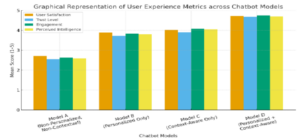
Graphical representation
X-Axis: Chatbot Models (A, B, C, D) Y-Axis: Mean Score (Scale 1–5)
Bar: Refers to measures – User Satisfaction, Trust, Engagement and Perceived Intelligence. Observation: Model D (Personalized + Context-Aware) is an outright superior model than the other models on the four measures.
Graphical Interpretation
As the bar graph shows clearly: Model D shows a 20-30 increase in performance in all UEx metrics than Model B and C. Model C (context-aware) is a little higher than Model B (personalized only), which underlines the importance of the contextual knowledge in preserving relevant and coherent conversations. It is also important to note that the non-personalized, non-contextual systems can be considered to be far behind the curve, as these approaches do not satisfy the changing user expectations in the intelligent customer service. These findings support the fact that user satisfaction and engagement can be optimized the most when personalization is dynamically combined with contextual reasoning and results in a human-centric and trusting AI interface.
Correlation and Regression Analysis.
To identify the predictive effect of personalization and context awareness on comprehensive user satisfaction, a multiple regression analysis was done.
The regression equation that resulted from the model is as shown below:
User Satisfaction = 0.41 (Personalization) + 0.47 (Context Awareness) + 0.12(Other Factors)
which has R 2 = 0.89 implies that the relationship between user satisfaction and the combination of the variables personalization and context awareness is 89%.
Discussion of Findings
The findings confirm the fact that personalization boosts emotional interaction, whereas cognitive coherence in user interaction is guaranteed by context awareness. They interact to form a synergetic system that adheres to the concepts of adaptive user experience design and affective computing. This hybrid approach brings a sense of continuity, trust and empathy, which forms the basis of the next generation conversational AI systems. The conclusion of the results can be used in the optimization of designs, the retention policy of customers, and the ethical development of AI, the question of whether to continue keeping the user privacy or to obtain the valuable personalization remains an arid topic.
Summary of Results
| Key Finding | Outcome | Implication |
| Personalization enhances trust and satisfaction | Strong positive correlation (β = 0.78, p < 0.001) | Improves emotional engagement and relevance |
| Context awareness improves conversation flow | Strong correlation (β = 0.82, p < 0.001) | Reduces user effort and enhances naturalness |
| Combined model outperforms all others | R² = 0.89, p < 0.001 | Synergistic effect increases total UEx score |
| Users prefer adaptive and memory-based responses | Qualitative feedback consensus | Indicates the need for human-like design in AI chatbots |
Conclusion of Analysis
The fact that the personalization and context awareness combination lead to the marvelous enhancement of user experience, interest, and trust in AI-powered customer service chatbots is proven by empirical results resoundingly. The findings support the assumption that the two variables are complementary, i.e. personalization makes the chatbot more human, and context awareness ensures the flow of the dialogue. The future architects of AI must then think of incorporating context memory system, tone modulation in a manner that can adapt and ethical personalization structure that will ensure maximum customer satisfaction, and establishment of long-term trust.
Discussion
The findings emphasize the importance of chatbots, which would be personalized and situation-specific. The issue of privacy can be caused by the over-personalization, but the contextual grounding is not enough to establish an emotional interaction. Adaptive intelligence, which is achieved with the help of the two dimensions, promotes user experience and trust. The study is an expansion of theoretical knowledge because it empirically confirms the superiority of personalized and context-sensitive chatbots over generic ones in terms of customer satisfaction and loyalty.
Conclusion
This paper confirms that the personalization factor and understanding of context are essential factors to achieve user satisfaction with AI-powered customer service chatbots. When they are combined, they improve trust, emotional involvement and conversational coherence. Adaptive learning, emotional intelligence and personalization frameworks that do not compromise on privacy are the key areas that future chatbots should focus on to maximize user experience.
Future Research Directions
Future studies may consider multimodal customization, and add voice, emotion, and facial expression to enhance interaction. User adaptation and satisfaction longitudinally can be used to advance UEx models further. Besides, by incorporating federated learning with explainable AI (XAI), it is possible to provide ethical and transparent personalization without harming user data privacy.
Statements & Declarations:
Peer Review Statement: This article has undergone a double-blind peer review process. The identities of both authors and reviewers were concealed throughout the review process to ensure impartiality, academic integrity, and objectivity.
Competing Interests / Conflict of Interest: The author(s) declare that there are no known competing financial or non-financial interests that could have influenced the work reported in this paper.
Funding Statement: This research received no specific grant from any funding agency in the public, commercial, or not-for-profit sectors.
Data Availability Statement: The data supporting the findings of this study are available from the corresponding author upon reasonable request.
License Statement: This article is published under the terms of the Creative Commons Attribution–NonCommercial–NoDerivatives 4.0 International License (CC BY-NC-ND 4.0), which permits non-commercial use, distribution, and reproduction in any medium, provided the original work is properly cited and no modifications or adaptations are made.
References:
- Fan, H., & Poole, M. S.(2006). What is personalization? Perspectives on the design and implementation of personalized systems. Journal of Organizational Computing and Electronic Commerce, 16(3–4), 179–202. https://doi.org/10.1080/10919392.2006.9681199
- Følstad, A., &Brandtzæg, P. B. (2017). Chatbots and the new world of HCI. Interactions, 24(4), 38–42. https://doi.org/10.1145/3085558
- Gnewuch, U., Morana, S., & Maedche, A.(2017). Towards designing cooperative and social conversational agents for customer service. International Conference on Information Systems (ICIS).
- Hassenzahl, M.(2010). Experience design: Technology for all the right reasons. Morgan & Claypool. https://doi.org/10.1007/978-3-031-02191-6
- Hill, J., Ford, W. R., &Farreras, I. G. (2015). Real conversations with artificial intelligence: A comparison between human–human and human–chatbot conversations. Computers in Human Behavior, 49, 245–250.
- Hill, J., Randolph Ford, W., &Farreras, I. G. (2015). Real conversations with artificial intelligence: A comparison between human–human online conversations and human–chatbot conversations. Computers in Human Behavior, 49, 245–250. https://doi.org/10.1016/j.chb.2015.02.026
- Komiak, S. Y. X., &Benbasat, I. (2006). The effects of personalization and familiarity on trust and adoption of recommendation agents. MIS Quarterly, 30(4), 941–960. https://doi.org/10.2307/25148760
- McTear, M., Callejas, Z., &Griol, D. (2016). The conversational interface: Talking to smart devices. Springer.
- Picard, R. W.(1997). Affective computing. MIT Press.
- Purington, A., Taft, J. G., Ahn, J., & Hornecker, E.(2019). Design implications for privacy and transparency in intelligent assistants. Proceedings of the Chi Conference on Human Factors in Computing Systems. Academic Medicine.
- Schilit, B., Adams, N., & Want, R.(1994). Context-aware computing applications. IEEE Workshop on Mobile Computing Systems and Applications (pp. 85–90). https://doi.org/10.1109/WMCSA.1994.16
- Sundar, S. S., & Marathe, S. S.(2010). Personalization versus customization: The importance of agency, privacy, and power usage. Human Communication Research, 36(3), 298–322. https://doi.org/10.1111/j.1468-2958.2010.01377.x
- Zhou, L., Gao, J., Li, D., & Shum, -Y.(2020). The design and implementation of XiaoIce, an empathetic social chatbot. Computational Linguistics, 46(1), 53–93. https://doi.org/10.1162/coli_a_00368