
 Share
Share
ABSTRACT
The Rural-Development remained a favourite arena of vested political-games of the Developing Economies in the region. After more than 75 years of independence, India is still concerned about widened disparities in growth and development. The underdeveloped and backward regions are getting more and more marginalized. These regions are Rural-Areas, and, these Areas are comprised of Villages – Villagers. Generally, and factually well known, that Development of the Area is directly related to Knowledge-Base / Knowledge-Pool, present, and adopted, by the inhabitants. Higher and more Refined the Knowledge, Higher will be the Quality of the Life – Living (Livelihood). The AI, as digital technology, has been seen as a tool to reach the Village-Masses (precisely the Citizens having basic foundational education level and the Desire to transform from Backwardness, created by the
Systems intentionally to control the rustic-masses, to Modern Refined Knowledge – Skills acquired Group) and bring social-change and economic-development in Rural-Areas. The AI (well-known form of Digital Technology) should be so made to be evolved that it benefits the backward population to move forward equally, without any Burden of Ancient Traditions – Practices or Civilizational-
Supremacy / one-upmanship. This research-study has been an effort to get new insights and aspirations of villagers (specifically the Educated Rural Youth) in the region through Primary Data-Collection Sample Survey and other Secondary Sources available in public-domain; which has further been put to statistical operations for analyzing and, thereby getting inductive – deductive descriptive and inferential conclusions, empirically, for the benefit of all the stakeholders.
Keywords: Rural-Development, Arena, Political-Games, Backward, AI, Ancient, Traditions, Practices.
Introduction
There has been still, the need being felt to discuss the Issues with rural-masses , so that they can be uplifted from backwardness ( the backwardness at social – religious – educational – political – cultural – economic levels), in itself has been appropriately considered as enough, to readily accept that Knowledge-Base / Knowledge-Pool in Rural-Areas (RA) has been in current scenario / modern world / at least after 2000, useless – obsolete completely (and masses should go through the process of Learning – Unlearning – Relearning). Due to this Traditional – Cultural Knowledge (for the last 2500 years) rural regions remained embroiled in Chaotic Life – Living. This Traditional – Cultural Knowledge is based on Ancient-Books, the words and information given, have been taken as the only truth (in these Books it has been mentioned that Life on this Land is Chaotic – Filthy – Painful, and community should do penance and remain indifferent, whereas, simultaneously remain unmindful of ‘the present’ but remain attached to ‘the past – the future’, that is, silently silently endure the suffering, from ‘Depression and Anxiety’ (the past and future) and, remain ‘Stressful’ because of ‘the present’. Any change (i.e., organized / well-managed Life – Living: Sustainable-Development) in this Status Quo will prove the Ancient-Books wrong, and that is ‘The Sin’ which is unacceptable. Because, when India / Region will become ‘Switzerland’, then the Ancient-Knowledge / Ancient-Books professing Painful (since childhood) Human Existence on this mother planet will be proved wrong, and thus amounting to Anti-social / Blasphemy / Atheistic. There is no scope – hope from traditional knowledge (efforts to sieve or make indigenous, would be in vain / futile / masquerading; wastage of time – money (separating low muster-seeds from high quality mustard-seeds out of a huge heap; also like, trying to segregate and fix something, the brand new one of which is cheap and easily available in abundance (i.e., the researched – refined – modern – structured and Quality Life-Living Systems / Ways) ) ).
Review of Literature
Absence of refined knowledge and life-living (Life: Quality of Life and, living: Dignified Livelihood Source) in any region compulsorily attract Plan-Policies-Programs for establishment of educational infrastructure, even after quiet a long period of time since attaining independence, as is the case with India and Rural Regions (RR) in it. Similarly, in the forward to Y S Rajan’s book Way Beyond 3 Billion, Dr Kalam summarized the employment mission in connection with Education; ‘… during schooling and college graduation students should be taught economically and socially relevant curriculum as well as, proficiency in skills-set.…Real-Education (RE) enhances the dignity of masses and increases self-reliance… therefore, Quality Education for all and value-added employment as per education — skills-set. Youth of India (Rural-Regions) should learn more and be able to communicate better and participate in the World Knowledge Economy…They have traditional knowledge about (only) fishing… and lacked proper knowledge about other things related (moder Refined knowledge) pre-post management… Their village need and were interested in learning about new technology (modern knowledge). This lack of Knowledge hinders Economic Growth & Development… Hence objective has been the delivery of Educational Infrastructure & Knowledge to Village masses at regional levels and bridging the gap, i.e., taking knowledge to the masses, so as to reach larger rural audience with (p&r: proper and relevant) Education and Knowledge… Large scale divide exist between rural and urban areas in the form of Income Levels and Quality of Amenities…; to remove this … activities have to be coupled with modern education, management and techniques / technology, for employing best operational practices and developing Local Competencies and change the ways (rural) masses live their lives… Real Development is to realize a Society and Physical Environment… where villagers can Live in clean, organized, informed environment, without poverty and, experience peace… The benefit that can be given to rural population in the region is to empower them with Knowledge – Information and Wisdom to improve the QoL… bring development using Natural Resources Optimally… In Rural Areas this involves investing in (Knowledge & Information), Irrigation, infra… However, agriculture has stopped growing… and, unorganized sector… comprised of self-employed poor, who live on sustainable wages, and has not seen any improvement…’ (Kalam & Rajan, 2014.)
Rural-Areas have been intentionally neglected, can be gauged by the fact that there have been still plans to establish infrastructure in rural areas; ‘… Lack of Quality-Infra, Lack of Quality Health-Care, and Lack of Quality Education, still makes life hard in many villages, …the first priority for societal transformation is accelerated Rural Development (RD)… these are the regions which have missed Industrial Revolution and IT Revolution, including Green Revolution. The transformation of our Rural Areas to a Knowledge Society is therefore our only keys to rapid Growth and Development, culminating in Rural Transformation (i.e., Higher SoL (Standard of Living) & Higher QoL (Quality of Life)) … and through PURA (Providing Urban Amenities in Rural Areas / Providing Quality Infrastructure Rural Regions (PQIRR)), it can be achieved easily. …. Mobile based Internet access aimed at providing Knowledge and Skill Enabling Services is going to be remarkable in this effort…. We need to Skill-enable and Knowledge-enable (Rural Youth), which will create sustainable systems in every sphere of National Life…’ (Kalam, 2014).
Modern Knowledge which has been inclusive of Dos & Don’ts, Holistic Personality Development and 360° Assessment have been given importance world over since 80s; ‘… Kalam wanted 03 traits – righteousness, creativity and courage, and gave it the form of equation, which he calls Knowledge Equation, and forcefully said that Knowledge Makes You Great… with 03 simple words he outlined the Pathways to Greatness…’ (Kalam, 2016).
Traditions are part of Culture in general; whereas, traditions are transmitted from one generation to the next in continuum, and therefore it has been accepted that present backward-ness in all almost all the aspects of village life is the outcome of past, that is knowledge of life and living remained free from modern refined information and knowledge in Rural Areas (which is explicitly reflected in the villages even today (non-diluted backward life – living)); ‘… culture is commonly accepted manners of behaving / doing something in a society, place and time,…Culture refers to the Pattern of Thoughts and Behavior of People, including rules, conduct and pattern of social organization, and also passed from one generation to other by formal- informal methods. It consists of ways in which we think and act as a society. This further act as a base and, comparatively sums-up as forward – backward culture and traditions. It expresses itself through social habits – social dealings, social setup; intellectual activities based on non-material aspect, which is evident in level of techniques – management being used in landscaping, production, trade-commerce… on the basis of this we can deduce the ways and life – living of a society… English word ‘culture’ is from Latin term cult / cultus, meaning cultivating, refining…, i.e., refining things so that end result evokes admiration, acceptance and respect, this is partially same as ‘sanskriti’ of Sanskrit language… The villagers in India are very closely related to their village (which can be taken as Dubious Distinction, as they have not done much to make it at least, even, Developing); ‘…while arguing that Indian Peasants indeed were conservative… the conservatism of the peasants has not been without reason, and, agricultural practices are embodying of what they do, as the experience of centuries… and loath to change them… Though very few customs and beliefs have been vanishing… It has also been found that villagers have deep sense of identification with their village… and, look-down upon by others have to be reciprocated forcefully… and also, they have varied views and world-view… along with social -ritual obligations sanctioned and sustained by generally accepted (hidden rules) conventions; characterized by economic, social and ritual cooperation (domination) existing between different classes… Also, due to non-monetized and minimally monetized economy, very little spatial mobility (in-spite of history of living) is evident along with limitations in the Indian Conditions regarding way of living, thinking and feeling, and having conflict with the outside world… and one portion of villagers could bring the system to a standstill by refusing action / cooperation (Jodhka, 2020.)
Modern knowledge have never been used by the systems in rural regions completely at village level on account of losing the civilizational ancient-ness and supremacy, thereby, thus remained in at a point of time without growth and developed-ness, ‘…Poor villages have to depend on traditional techniques and indigenous knowledge, … therefore, it is necessary to resolve this problem of using only minute portion of modern knowledge (MK) and, eventually blaming it (MK) for all the mis-management …The probable solution, that is why is making use of multidimensional – multidirectional, as well as sensitive – sustainable parts of modern knowledge in cohesion… And without using the ‘tolls of cultural-lag’… and move towards complex social structure (not fore-granted simple structure, and accepting the given i.e., limited needs of rural masses) along with, becoming more civilized in terms of techniques and other aspects of life in the society…’ (Gupta, 2015.)
Objective of the Study
The aim of this research effort has been to bring out empirically the actual required changes in the rural areas and among villages – villagers in the region as a whole. It has been the observation that villages in India can be taken as having uniformity in most of the issues, as most of them have been found to be backward – traditional and still (trapped in the game of) developing. The following objectives have been taken for this study.
- To study the Villages – Villagers’ Life-Living of Rural Areas.
- To get the new insights regarding issues of and solutions for Rural Human-Capital.
Methodology
This research effort remained an endeavor to empirically analyze the Villages – Villagers. The literature consulted and relied upon have been of seminal nature, where it has been repeatedly pointed out that villages – villagers in India are backward and traditional (along with Traditionalist). Almost all have commonly acquired features like underdeveloped-ness, absence of (Quality) rural infrastructure, ancient social structure, lower economic scenario, politically exploited and unaware of benefits of institutionalized -instructions and structured skill-training based educational curriculum. This research effort relied on primary data as much as, on secondary data (in the form of research journal, national-international govt – non-govt literature in the form of reports, journals, books and, literary work of eminent personalities at the helm of affairs) available in public domain including online.
This study is descriptive, dialogic, grounded and inferential technique based; so as to get, at least complete picture of the points, from where India should start forward journey. This study collected primary information directly from the Educated Rural Youth in the villages of two sub-divisions (Dehra and Jawalamukhi) in district Kangra in Himachal Pradesh. These respondents ended up being 40 in number; contacted on the basis of stratified random sampling technique, where the population comprised of educated rural youth in the age-group of 16-25 years, in the months of July – Sep 2025; keeping in view the time – money resources available. The information has been collected from respondents through diligently developed questionnaire-cum-schedule, having 19 open as well as close ended questions, with few based on Likert-type 5 / 7-point scale. Later-on data collected have been subjected to statistical testing having relevant hypotheses, thereby helping in presenting the analysis – evaluation and suggestions. Data has also been represented graphically for readily decoding the overall scenario.
Data Presentation
Awareness among Educated Youth (in Rural Regions also) have gone much higher due to IT revolution and IoT. This research effort has also noticed such change while collecting primary data from the field. The empirical evidence has been substantiated by the following graphical presentation of insights and information extended by Educated Rural Youth (ERY), which has also been the respondent.
It has come to the fore that Village life-living in Developed World (DW) (/Higher Income Countries) have changed and become highly organized – well-managed due to part played by the Quality Education and Skills based Educational-Curriculum; along with Well-Structured Complex Modern Organizations – Institutes and, Refined Social Structure / Life-Living (Northern Europe, New Zealand, North America, Japan etc.). But India has been struggling with its ‘Dualisms’ (especially of Prof J. H. Boeke and Prof B Higgins) since ancient times.
The respondents, well acquainted with realities of world, know that village life-living in DW has already changed a lot and, now has been well-organized due to Quality Education and Skills, because of these social -cultural – economic outlook changes and brings village-development. it has also been stressed by the respondents that level of Modern Refined Knowledge is higher in DW. Developed thus achieved is the indicator of Development of Village. As per respondents also, modern Refined Knowledge through General Education System and Curriculum is the responsibility of the Govt Depts, not NGOs, Foreign Missionaries, Religious Organizations or Social Organizations.
Table 1: Developed World, Village, and Management
| Sr no. | Item / Issue | Percentage |
| 1. | Village Life-Living has already the changed-one in Developed World | 95% |
| 2. | Village Life-Living in Developed World is Well-Organized | 95% |
| 3. | Well-Organized Village Life-Living is caused by Quality-Education & Skills | 90% |
| 4. | Quality Education – Curriculum inclusive of Skills change Social – Cultural – Economic Outlook of Villages | 90% |
| 5. | Development is the Indicator of Well-Organized Village Life-Living | 100% |
| 6. | Level of Modern & Refined Knowledge is Higher in Villages of Developed World | 95% |
| Source: Primary Data By Author, Aug-Oct 2025. | ||
It is clear from the table above that Village – Villagers in DW are Developed, Well-Organized, having higher level of Modern – Refined Knowledge, because of changed Social – Cultural – Economic Outlook of masses on account of Quality Education – Curriculum. Thus, it has been taken as the obvious base for the comparison with the Villages-Villagers in the region (the conflict due to Dualisms presents in the Lower & Lower Middle-Income Countries / Less Developed Countries).
Fig 1: Developed World, Villages-Villagers, Quality Education – Curriculum & Management
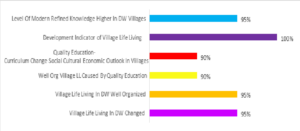
Source: Primary Data By The Author, Aug-Oct 2025.
It has been reiterated by respondents as well that providing Quality Modern Refined Knowledge – Skills through general education system should be the responsibility of Government-Systems.
Fig 2: Responsibility of Providing Modern Refined Knowledge – Skills Through General Education System
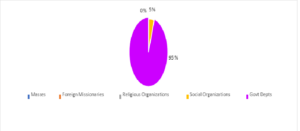
Source: Primary Data by the Author, Aug-Oct 2025.
On comparing the Indian Villages – Villagers (V-V), following picture has come out, where it has been clear that V-Vs in the region is Traditional – Backward, including Knowledge Base (Pool / Human Capital). Similarly, this backwardness / traditional knowledge has been viewed as the main cause poor Life – Living in the rural areas (here, this prevalent scenario has once again reiterated that social – cultural environment plays a vital role role in shaping the V-Vs and actually bringing and establishing the growth – development sustainably). This negative factor has also been strongly advocated by the respondent as the responsible point for absence of Ease of Live – Living in rural areas.
Table 2: Knowledge Base, Cause and Absence of Ease of Life – Living
| Sr. no. | Issue | Percentage |
| 1. | Villages – Villagers in the region are Traditional – Backward | 90% |
| 2. | Knowledge Base/Pool in Villages – Villagers is Traditional – Backward | 80% |
| 3. | Traditional – Backward Knowledge is the cause of poor Life – Living in Villages | 80% |
| 4. | Ease of Life – Living is absent in Villages | 100% |
| Source: Primary Data by the Author, Aug-Oct 2025. | ||
Here, in the given table and figure (2 & 3, respectively), it has been depicted that rural regions in India as a whole, suffers from absence of life living due to traditions – backward knowledge
Fig 3: Knowledge Base, Cause and Absence of Ease of Life – Living
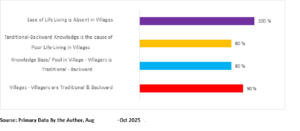
During research and data collection, important issues have come to the fore, like villagers under some community-leader (having any type of power) dominates the dwellers and collectively avoid adopting new refined – modern ways / knowledge, and take pride in their traditional – backward knowledge. It has been very categorically stated by respondents that Old-Religion based daily-life & traditions dominate village life – living, and, this knowledge – behaviour cannot bring SRD / RD (sustainable rural development / rural development).
Fig 4: Pride, Avoidance and Domination of old – Traditional – Backward Knowledge in Villages
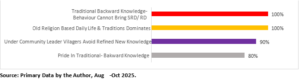
It has been clearly stated by all respondents that traditional-Backward Knowledge cannot bring SRD / RD in the region. On the other hand, modern refined new knowledge has become specific in modern times on account of research and development, as well as empirical (and equivalent to philosophy, Right / true at all times), similarly, villagers have less information – knowledge about benefits of new refined modern knowledge, therefore, most respondents have along with above insights, emphasized the adoption of modern refined and specific knowledge. They also showed concern about the proper definition of ‘Ruralization’ (the term not even coined or accepted popularly) inclusive of modern refined new knowledge, and then immediately implementing it without C&C (Corruption & Commission) in rural regions. Primary data here has been presented below graphically.
The stress has been given on non-diluted refined modern new knowledge, without political -social – religious indigenous – traditional inputs.
Table 3: Less Information – Benefits of Modern Refined New Knowledge among Villagers and, Ruralization
| Sr no. | Issue | Percentage |
| 1. | Knowledge have become more refined & specific in modern times | 95% |
| 2. | Villagers have less information about benefits of New Refined (Modern) Knowledge | 95% |
| 3. | villages-Villagers need appropriate Ruralization (defined & Structured) through education – skills
& Information |
100% |
| 4. | Ease of Life – Living and SRD / RD shall come by adopting: Traditional Knowledge
Indigenous Knowledge Western Knowledge Eastern Knowledge Modern Refined & Specific Knowledge Modern Refined & Specific Knowledge only
|
0% 0% 0% 0% 15% 85% |
| Source: Primary Data by the Author, Aug-Oct 2025. | ||
It has been emphasized by the respondents that in the contemporary era, especially after 2000, knowledge have become refined and specific; whereas, villagers in the region as a whole, have less information about the benefits of it. The ERY, that is the respondents, also stressed that villages villagers need immediately required – appropriate Ruralization, which should be well defined and structured (because RD have been exploited and abused far beyond in India on account of its being broader in scope, by the system at helm of affaires) directly, and also through education – skills & information at general education system infrastructure. It has also been brought forward on priority basis that ease of life – living can manifest only through modern refined – specific and holistic knowledge, without the complete interference from religious – social – political players (it should be apolitical – asocial – areligious); in other words, should be out of the filthy reach of these.
Fig 5: Less Information – Benefits of Modern Refined New Knowledge among Villagers and, Ruralization
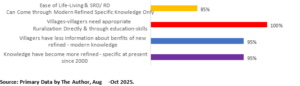
It has therefore here been taken as given that modern refined-specific holistic knowledge-based Ruralization shall only be the key for SRD / RD. this alternate insight has never been discussed in forums, most germane to the work of rural development in India till now.
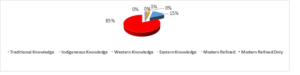
Fig 6: Knowledge required for Ease of Life-Living & Holistic SRD / RD in the Region
Source: Primary Data by the Author, Aug-Oct 2025.
It has been clear that the respondents have, here, clearly endorsed emphatically that Traditional Knowledge, Indigenous Knowledge, Western Knowledge, Eastern Knowledge cannot bring required holistic sustainable rural development or simple rural development, otherwise region would have developed villages – villagers. Majorly it has been stressed that only modern refined specific knowledge can bring real holistic sustainable development in villages – villagers.
This study has conducted general correlation and regression analysis on the primary data collected, where the variables related to quality education-curriculum based change in social-cultural-economic outlook and developed village life-living in developed world have been found to be correlated (with value of 0.37) and regression value of 0.72 (as in this study value of 0.20 – 0.90 have been taken as strong relationship) show that there is a strong relationship between dependent variable village life-living changed in developed world and independent variable (quality education – curriculum based social-cultural-economic outlook of villagers-villages).
Another result has substantiated the claim made above, where correlation between 02 variables, first being quality education-skills based well-organized village life-living in developed world and second variable being related to well-organized village life-living in developed world have been found to be positively correlated (r being 0.30) and, first being having higher positive relationship with the dependent variable of well-organized village life-living in developed world (having regression value of 0.80).
Similarly, higher overall correlation and regression-based relationship have been found between independent variable related to village life-living in developed world and development as the indicator of higher (well-organized) village life-living. With regard to villages-villagers’ in rural regions (of India), the correlation and regression between independent variable of Knowledge Base (pool)in Villages-Villagers is Traditional & Backward and dependent variable, the villages-villagers in rural regions, as a whole / universe, have been found to be positive (correlation and regression values being at 0.66 and 0.22 respectively), therefore it can be deduced that villagers – villages in the region is traditional – backward due to knowledge Base (pool) in villages – villagers have been traditional – backward. On the other hand, there has also been a positive correlation and regression (having value of 0.88 and 0.38 respectively) between independent variable of (dubious) pride in traditional – backward knowledge (pool) among villagers – villages and, dependent variable of villages – villagers being traditional – backward. Also, there has been positive relationship between dependent variable, that is villages – villagers are traditional – backward and independent variable where it has been the domination of community leader under which villagers collectively avoid adopting refined modern specific knowledge (having correlation and regression values of 0.72 and 0.30 respectively). It has also been found correlated positively along with positive relationship, between dependent variable related to poor life-living among villages-villagers and independent variable related to villagers-villagers being traditional – backward (having values of 0.50 and 0.66). another main issue that has come out has been strong relation between independent variable related to villages-villagers being traditional – backward and dependent variable regarding absence of ease of life-living in villages/ rural areas (having positive correlational and positive regression relationship values of 0.66 and 0.72). Development with the help of Modern Refined Knowledge based Knowledge-pool, thus has been the vital factor, without religious – political interference, for the sustainable change in rural areas.
Findings
This research effort has succeeded in accomplishing and bringing out all information as per objective of the study.
Regarding first objective about information and insights related to villages-villagers’ life-living; it can be easily stated, which has been substantiated by very obvious, that villagers – villages have not been developed yet, and are backward – traditional, also, life and living have been found to be lower for the majority of the population in rural areas. It has also been observed that villages – villagers in India can easily be classified under, only 01 or maximum 02 categories for almost all the issues prevalent in Rural Areas, due to uniformity of issues.
Whereas, with regard to second objective of issues and solutions related to rural human capital, that is rural knowledge pool, it has come to the fore clearly that population and milieu have been highly traditional and backward (ancient knowledge and practice-based). Villages – villagers do not have information and awareness about the benefits of modern refined specific knowledge about everything under the sun related to rural areas. It has been time and again stated by the respondents that modern refined knowledge should be immediately be made available in a structured way through already established wide general education network system, without segregating – separating the ERY and, mass scale awareness programs and modules be provided for the adults. The prevalent system has done no good for 2500 years, which can be explicitly witnessed all around, everyday – anytime in the daily life of rural masses. Life -Living Milieu cannot decline in a day or in a year; the lower knowledge pool and traditional-traditionalist play their respective regressive role and oppose any change in status quo.
Conclusion
It has been apt, to mention here that, villagers – villages have been the victim of traditionalists, who dominates the communities. These self-styled community-leaders, with half-baked little knowledge, endorse the idea that all knowledge – information have already been known in ancient times, which have been there now in ancient books / old books. They also stress that there is nothing left to be found – analyzed – adopt – change. Masses have to follow the traditions – practices, based on knowledge of olden times and situations.
Whereas, this empirical study has found that old-books and oldened-up knowledge have failed the system since olden times. Educated Rural Youth, that is, the respondents, have clearly supported the Refined Modern Specific Knowledge – Skills for the Sustainable Rural Development. This research effort also therefore, recommends the implementation of refined modern specific knowledge immediately, through already established General Education System in the country, and, special module-based interaction and self-study material for compulsory adult education so as to address the possible inter-intra generation communication gap and conflict.
However, as the AI has been found to be erratic – lop-sided, because it can be manipulated by vested interest people / systems. The AI can be highly useful only when the scope of it should be handled and earmarked by an impartial agency / authority, for all particular sections, to bring transparency – accountability – usefulness, for masses of all age-group.
The final recommendation, based on the observation, is that, it has to be stressed among rural masses that they have to adopt and adapt to Complex Social Structure, having easy and non-prejudiced, Ways to Respond – React – Reply – Behave – Deal; and, unlearn completely the Simple Social Structure / simple village life, having Animalistic Level of Behaviour – Response – Daily-Dealings in Rural Regions / Villagers – Villages.
Statements & Declarations:
Peer Review Statement: This article has undergone a double-blind peer review process. The identities of both authors and reviewers were concealed throughout the review process to ensure impartiality, academic integrity, and objectivity.
Competing Interests / Conflict of Interest: The author(s) declare that there are no known competing financial or non-financial interests that could have influenced the work reported in this paper.
Funding Statement: This research received no specific grant from any funding agency in the public, commercial, or not-for-profit sectors.
Data Availability Statement: The data supporting the findings of this study are available from the corresponding author upon reasonable request.
License Statement: This article is published under the terms of the Creative Commons Attribution–NonCommercial–NoDerivatives 4.0 International License (CC BY-NC-ND 4.0), which permits non-commercial use, distribution, and reproduction in any medium, provided the original work is properly cited and no modifications or adaptations are made.
References
- Gupta, A. D. Ways to study indigenous knowledge and indigenous knowledge system.
- Dept of Anthropology, University of North Bengal, India. 2015. isca.in. 17-8-25 / 19:42. Web.
- Gupta, K. R. (2003). Atlantic publishers and distributors. In Rural development in India– I’ (1st ed.). Nice Printing Press, nd. Print.
- Jodhka, S. S. From “book-view” to “field view”: Social anthropological constitution of Indian villages, Working Paper no. 05. Dept of sociology, university of Hydrabad, A.P. ssjss@uohyd.ernet.in.17-8-25 / 19:46. Web.
- (2011). Penguin Books India. APJ and Srijan Pal Singh. Target(1st ed.). Repro Knowledgecast Limited, 3 Billion’, 2011. Print.
- (2014a). Thomson Press (India). APJ, and V Poonraj. In A manifesto for change: A sequel to India 2020(1st ed.). HarperCollins Publishers Limited, nd. Print.
- (2014b). APJ, and Y S Rajan. In Beyond 2020: A vision for tomorrow’s India(1st ed.). Replika Press Pvt. Ltd., nd. Print.
- Kalam, & APJ. (2015). Penguin Books India. My India: Ideas for the future(1st ed.). Thomson Press India Ltd., nd. Print.
- ‘Knowledge and Technology for Sustainable Rural Development’. (n.d.). http://www.egyankosh.ac.in
- IGNOU-SLM. 17-8-25 / 19:43. Web.
- Lieten, G. K. (2003). Manohar Publishers and Distributors, nd. Power, politics and Rural Development: Essays on India(1st ed.). Lordson Publishers Pvt. Ltd.. Print.
- Mishra, Dr K. K. ‘Villagers’ Response To Development And The Identification Of The Quantitative Indicators Of Cultural Development’ National Seminar by Indira Gandhi National Centre For The Arts, and UNESCO. (17/8/2025) / 19:45 [Web]
- Narula, U. Dynamics of Indian rural economy; growth perspective, ed. (2010). Atlantic Publishers & Distributors (p) Ltd, New Delhi,. Nice Printing Press, U.P. Print.
- Orrell, D. (2021). Icon Books Ltd, London. Behavioural economics, ed. Print. Clays Ltd.
- Rajan, R., & Lamba, R. (2023). Penguin Random House India. Breaking the mould: Reimagining India’s economic growth(1st ed.). Thomson Press India Ltd., nd. Print.
- Ramachandran, P., & Rajkumar, V. (2018). Education in India, ed. Reprint. Print. National Book Trust. http://www.nbtindia.gov.in.
- Siddhartha Institute of Science and Technology, AICTE approved. (17/8/2025) / 19:44 [Web]. ‘Essence of Indian Traditional Knowledge’. Puttur, Karnataka, India
- Renshu, Juneja, P., Meenakshi. (2024). Examining the role of soil in promoting sustainable development and achieving the UN Sustainable Development Goals (SDGs). Shodh Sari-An International Multidisciplinary Journal, 03(03), 265–285. https://doi.org/10.59231/sari7734