
 Share
Share
Abstract
The economic viability and policy-driven adoption of rooftop solar systems represent a critical axis in India’s quest for sustainable energy security. This research investigates inter-state differences in rooftop solar adoption across Ten Indian States using secondary data on installations, average electricity tariffs, subsidy percentages, urbanization rates, and household income levels. Descriptive statistics, correlation analysis, multivariate regression, and ANOVA were used to assess how economic and policy variables influence adoption patterns.
The results reveal significant state-level variation in rooftop solar installations, not necessarily correlated with income or subsidy levels. Regression analysis suggests that subsidy percentage has a counterintuitive negative association with adoption, while income, tariff, and urbanization rates have minimal influence. ANOVA results further confirm that the difference in installations between high- and low-subsidy states is not statistically significant. These findings point to underlying structural and implementation inefficiencies in India’s rooftop solar policy landscape.
The study concludes that financial incentives alone are insufficient to drive adoption. Instead, factors such as policy execution, administrative transparency, consumer awareness, and innovative financing mechanisms are more crucial. The paper recommends moving toward decentralized, performance-based, and consumer-centric policies that go beyond subsidy-centric approaches. A reorientation of India’s rooftop solar strategy toward holistic and context-sensitive planning will be essential for realizing its renewable energy potential.
Keywords: Green Energy, Rooftop Solar Photovoltaic, Financial Viability of Renewable Energy, Regression analysis in Energy policy formulation
Introduction
The pursuit of sustainable energy security has emerged as a top policy priority for India, driven by rising energy demand, vulnerability to fossil fuel imports, and the global climate imperative. India’s energy landscape is undergoing a significant transformation, with a clear policy shift towards renewable sources, particularly solar energy. Among various solar solutions, rooftop solar photovoltaic (PV) systems have gained attention for their potential to decentralize energy production, reduce transmission losses, and empower consumers to become “prosumers” (Bhattacharyya, 2020; Sharma, Gupta, & Rao, 2020). The Indian government has set an ambitious target of installing 40 GW of rooftop solar capacity under the National Solar Mission (MNRE, 2024). However, as of early 2024, rooftop solar has contributed less than 20% of this target, signalling a significant implementation gap (CEEW, 2022; IEA, 2021). This underperformance is despite the availability of financial incentives such as capital subsidies, concessional loans, and net metering policies, which were expected to stimulate adoption (Ghosh & Kalra, 2018; Kumar & Kaushik, 2022). While large-scale solar parks have shown exponential growth, residential and small-scale rooftop solar adoption has been uneven across states, raising questions about the economic and policy drivers of this divergence (IEEFA, 2020; Rao & Patel, 2021).
The financial viability of rooftop solar is often highlighted as a critical determinant of adoption. The concept of “grid parity,” where the cost of solar power matches or undercuts conventional electricity tariffs, has been achieved in several Indian states (Sharma, Deshmukh, & Kumar, 2021). However, achieving grid parity alone does not guarantee adoption. Factors such as high initial capital costs, consumer risk perceptions, and long payback periods continue to hinder the uptake of rooftop solar in both urban and semi-urban households (Jain, Tripathi, & Mani, 2020; Singh & Mishra, 2022). Moreover, the cost-benefit perception is shaped by contextual elements like roof ownership, availability of space, financing options, and awareness of government schemes (Gupta & Bose, 2019; Chakrabarti & Chakrabarti, 2017).
From a policy standpoint, financial incentives such as central and state-level subsidies have been widely used tools to stimulate adoption. Yet, empirical evidence on their effectiveness is mixed. While some studies argue that subsidies improve affordability and payback periods (NITI Aayog, 2022; World Bank, 2021), others find that bureaucratic delays, lack of transparency in disbursement, and frequent changes in policy design undermine their impact (CEEW, 2021; Patil & Rajan, 2020). Further complicating matters is the role of DISCOMs (distribution companies), who may resist widespread rooftop deployment due to perceived revenue losses or administrative burden (Ghosh & Kalra, 2018; Sood & Ghosh, 2018).
Geographical and socio-economic disparities further accentuate the complexity. For instance, states like Gujarat and Maharashtra have shown strong growth in residential rooftop installations due to proactive state policies and robust implementation frameworks (Saur Energy, 2023; The Hindu, 2024). In contrast, populous states like Uttar Pradesh and Bihar lag behind despite having a large potential consumer base and access to subsidies (CEEW, 2020; Times of India, 2025). This heterogeneity suggests that adoption is not solely dependent on economic indicators like income or electricity tariffs, but is influenced by a matrix of factors including awareness, administrative ease, policy continuity, and local governance capacity (Vyas & Prasad, 2019; Jain et al., 2020).
In this context, it becomes crucial to investigate the extent to which economic viability and policy incentives correlate with actual adoption outcomes, especially in a federal structure like India where state-level policy implementation varies widely. While prior studies have focused on consumer surveys or case-specific feasibility models (Sharma et al., 2020; Bhattacharyya, 2020), few have attempted a comparative quantitative analysis across multiple states using real adoption data. This study aims to bridge that gap by using secondary data to analyse the economic and policy dimensions of rooftop solar adoption across ten major Indian states.
Accordingly, the specific objectives of this paper are:
- To evaluate the economic viability of rooftop solar systems across Indian states by analysing average income, electricity tariffs, and urbanization rates.
- To examine the impact of financial and policy incentives (especially subsidies) on rooftop solar adoption.
- To identify inter-state variations in adoption and explore potential policy implications based on empirical findings.
By integrating statistical analysis tools such as descriptive statistics, correlation, regression, and ANOVA, this paper provides a structured, evidence-based insight into what drives or hinders the adoption of rooftop solar in India. The findings have direct policy relevance for both central and state governments, energy regulators, and private sector actors seeking to scale decentralized renewable energy in the country.
Literature Review
Economic Viability of Rooftop Solar in India
The economic feasibility of rooftop solar photovoltaic (PV) systems in India has been extensively studied, highlighting factors such as declining installation costs, rising grid tariffs, and government incentives. According to the International Energy Agency (IEA), policy, regulatory, and administrative challenges, along with limited financing options, hinder the rapid expansion of rooftop installations in India. The Council on Energy, Environment and Water (CEEW) conducted a bottom-up assessment, revealing that the technical potential for residential rooftop solar in India is significant, yet actual deployment remains limited. Studies have shown that the payback period for residential rooftop solar systems varies across states, influenced by factors such as state-specific tariffs and subsidies. For instance, Sharma et al. (2021) found that in urban areas, the payback period ranges between 5 to 7 years. Singh and Mishra (2022) emphasized the importance of financial feasibility in residential rooftop solar adoption, noting that favourable economic conditions can significantly boost uptake.
Policy Incentives and Adoption
Government policies play a crucial role in promoting rooftop solar adoption. The Ministry of New and Renewable Energy (MNRE) provide central financial assistance, while states offer additional incentives. For example, Gujarat offers a 40% subsidy for systems up to 3 kW. Net metering policies, which allow consumers to feed excess electricity back to the grid, vary across states and impact the financial returns of solar investments. The Pradhan Mantri Surya Ghar: Muft Bijli Yojana aims to install rooftop solar systems in 1 crore households, providing up to 300 units of free electricity per month. As of May 2025, Gujarat leads in installations under this scheme, followed by Maharashtra and Uttar Pradesh. ([thehindu.com][3], [timesofindia.indiatimes.com][4])
State-Level Disparities in Adoption
Adoption rates of rooftop solar systems differ markedly among Indian states. Gujarat, Maharashtra, and Rajasthan have made significant strides due to proactive policies and streamlined approval processes. In contrast, states like Bihar and Odisha lag behind, facing challenges such as bureaucratic hurdles and lack of public awareness. The Council on Energy, Environment and Water (CEEW) highlights that asymmetries in information and varying state policies contribute to poor uptake of grid-connected rooftop solar. Furthermore, the India Residential Energy Survey (IRES) indicates that awareness and financial constraints are significant barriers to adoption in certain regions.
Financial Models and Market Potential
Innovative financial models, such as community-based demand aggregation and peer-to-peer influence, have shown promise in increasing rooftop solar adoption. The Solarise Delhi campaigns, implemented by CEEW, demonstrated the effectiveness of these approaches in urban areas. ([ceew.in][6]). The Institute for Energy Economics and Financial Analysis (IEEFA) reports that India’s residential rooftop solar market is poised for significant growth, driven by rising demand and supportive government policies. However, challenges such as limited financing options and reluctance of utility distribution companies (DISCOMs) persist.
Technological and Social Factors
Technological advancements, including the use of satellite imagery for solar potential analysis, have enhanced the feasibility assessments for rooftop solar installations. Social factors, such as consumer awareness and behavioural intentions, also influence adoption rates. Kumar and Kaushik (2022) utilized structural equation modelling to analyse households’ intention to purchase solar rooftops, emphasizing the role of trialability and observability in the diffusion of innovation.
Methodology
This study adopts a quantitative research approach using secondary data analysis to examine the economic viability and policy-driven adoption of rooftop solar photovoltaic (PV) systems across ten major Indian states. The rationale behind selecting this approach is that secondary datasets from reliable government and institutional sources provide access to standardized, validated, and up-to-date statistics essential for cross-state comparative research.
Data Sources and Variables
The data used in this study were collected from publicly available sources, including:
MNRE (Ministry of New and Renewable Energy) reports for state-wise rooftop solar installations, State Electricity Regulatory Commissions (SERCs) for average electricity tariffs, Government budget documents and state-level policy reports for subsidy percentages, Census of India (2011) and MoSPI (Ministry of Statistics and Programme Implementation) for urbanization and average household income figures. The following variables were selected based on their theoretical and empirical relevance to the adoption of rooftop solar systems:
- Dependent Variable:
Number of rooftop solar installations (as a proxy for adoption)
- Independent Variables:
Average electricity tariff (INR/kWh)
State-level subsidy percentage (%) for rooftop solar
Urbanization rate (%)
Average household income (INR/year)
These variables help capture both the economic and policy dimensions of rooftop solar viability.
Descriptive and Correlation Analysis
Descriptive statistics were used to summarize the central tendency and dispersion of all variables across the ten states. This step helps identify general trends, outliers, and variation in rooftop solar adoption and the influencing factors. A Pearson correlation matrix was constructed to examine the strength and direction of linear relationships among the variables. This allows an initial exploratory understanding of which independent variables might have the most influence on adoption rates.
Regression Analysis
To evaluate the joint effect of multiple predictors on rooftop solar adoption, the study employed a Multiple Linear Regression model. This method is appropriate as it quantifies the influence of each independent variable on the dependent variable, holding other factors constant. The regression model estimates the extent to which factors such as tariff, subsidy, urbanization, and income predict variations in installation numbers. The use of Ordinary Least Squares (OLS) estimation is justified due to its robustness in modelling continuous outcomes and its interpretability for policy-relevant results. Standard diagnostic checks (including R-squared, p-values, and standard errors) were applied to assess model reliability.
ANOVA (Analysis of Variance)
To further test the impact of subsidy rates on adoption, an ANOVA test was conducted by categorizing states into “high subsidy” and “low subsidy” groups. ANOVA helps determine whether the difference in mean installations between these groups is statistically significant. This method is suitable for evaluating group-level policy impacts, particularly when the independent variable is categorical (e.g., subsidy level groupings) and the dependent variable is continuous (number of installations).
Justification of Methodological Approach
The use of secondary data and statistical modelling is justified given the macroeconomic and policy-level focus of this research. Primary data collection was not feasible due to the geographic scope and infrastructural diversity involved. Moreover, the chosen quantitative methods provide a systematic, objective, and replicable framework for measuring economic and policy influences on solar adoption. The inclusion of multiple statistical tools ensures robustness, while alignment with policy-relevant indicators ensures practical utility.
Data Analysis and Findings
Descriptive Statistics
A preliminary exploration of the dataset reveals key variations across Indian states in rooftop solar adoption, influenced by economic and policy indicators. Table 1 provides the descriptive statistics:
Table 1: Descriptive Statistics of Variable
| Variable | Mean | Std. Dev. | Min | Max |
| Installations | 184,817 | 47,179 | 104,886 | 263,458 |
| Avg_Tariff (INR/kWh) | 5.26 | 1.48 | 3.50 | 7.47 |
| Subsidy Percentage (%) | 27.06 | 6.53 | 20.14 | 39.48 |
| Urbanization Rate (%) | 53.84 | 11.71 | 30.53 | 69.33 |
| Avg Income (INR/year) | 209,674 | 50,300 | 117,159 | 274,073 |
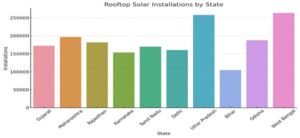
The data indicates that rooftop solar installations vary significantly across states. States like West Bengal and Uttar Pradesh reported the highest adoption rates, whereas Bihar and Karnataka had relatively fewer installations. Interestingly, the average income and urbanization rates also showed considerable disparities, hinting at possible socio-economic influences on adoption levels.
Correlation Analysis
To examine interdependencies, a correlation matrix was generated (see Figure 1). Notably:
- Installations vs. Subsidy Percentage shows a moderate negative correlation (-0.62), which is counterintuitive and warrants deeper analysis.
- Avg_Tariff and Urbanization Rate show weak correlations with installations (0.28 and 0.23, respectively).
- Avg_Income has a weak positive correlation (0.18) with installations.
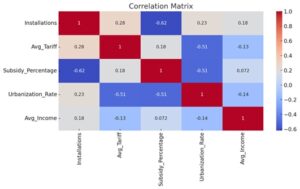
These results imply that higher subsidies may not always lead to more installations, potentially due to inefficiencies in subsidy disbursement, awareness gaps, or policy fragmentation.
Regression Analysis
A multivariate Ordinary Least Squares (OLS) regression was conducted to model the number of rooftop solar installations as a function of four key predictors: average tariff, subsidy percentage, urbanization rate, and average income.
Regression Equation:
Installations = β0 + β1(Avg_Tariff) + β2(Subsidy_Percentage) + β3(Urbanization_Rate) + β4(Avg_Income) + ε
Table 2. OLS Regression Results
| Predictor | Coefficient | Std. Error | t-value | p-value |
| Intercept | 100,300 | 169,000 | 0.593 | 0.579 |
| Avg_Tariff | 17,490 | 10,100 | 1.733 | 0.144 |
| Subsidy_Percentage | -4,510 | 2,239 | -2.015 | 0.100 |
| Urbanization_Rate | 925 | 1,457 | 0.635 | 0.553 |
| Avg_Income | 0.309 | 0.257 | 1.201 | 0.284 |
R-squared = 0.65, Adjusted R² = 0.37, F-statistic = 2.324, p = 0.19
Despite a decent R-squared value, the p-values suggest that none of the predictors is statistically significant at the 0.05 level. However, Subsidy_Percentage (p = 0.100) is near significance, indicating a negative impact — higher subsidies are possibly correlated with fewer installations. This could be due to poor subsidy penetration, lack of trust in government reimbursements, or unawareness among eligible households.
Multicollinearity is not high, but caution is advised due to the relatively small sample size (n=10), which limits statistical power.
ANOVA: Impact of Subsidy Levels
To assess whether subsidy levels significantly impact installation numbers, states were grouped into “High” (>30%) and “Low” (<30%) subsidy categories. An ANOVA test was performed to evaluate differences between these groups.
Table 3. ANOVA: Installations by Subsidy Group
| Source | Sum Sq | df | F | p-value |
| Subsidy_Group | 3.81e+09 | 1 | 1.88 | 0.207 |
| Residual | 1.62e+10 | 8 |
The p-value (0.207) indicates that there is no statistically significant difference in average installations between high and low subsidy groups. This supports the regression result and further suggests that mere subsidy levels are insufficient to influence adoption; other factors such as awareness, administrative ease, and upfront costs may matter more.
Interpretation in Light of Research Objectives
Objective 1: To evaluate the economic viability of rooftop solar systems in Indian states.
- While higher income and urbanization levels show a mild positive trend with installations, their influence is not statistically robust. The wide dispersion indicates that economic viability is context-sensitive, affected by state-level cost structures, policy implementation efficiency, and access to credit or technology.
Objective 2: To analyze the effect of financial and policy incentives on adoption.
- Both regression and ANOVA suggest that subsidy levels alone do not drive adoption. The negative regression coefficient and statistically insignificant ANOVA results point to underlying issues such as bureaucratic hurdles, inadequate consumer knowledge, and lack of infrastructure for subsidy delivery.
Objective 3: To identify inter-state variations and determine policy implications.
- Substantial variation across states underscores the need for localized policy design. States like West Bengal and Uttar Pradesh may be succeeding due to better consumer targeting, vendor networks, or solar agency effectiveness, rather than purely financial incentives.
The present study aimed to assess the economic viability and policy-driven adoption of rooftop solar systems across ten major Indian states, using publicly available secondary data and quantitative statistical tools. The analysis provides several critical insights into the interaction between economic factors, policy incentives, and actual deployment outcomes in the rooftop solar sector.
The descriptive analysis revealed wide inter-state variability in solar rooftop installations, with some economically modest or low-subsidy states outperforming others with higher financial incentives. While states like Uttar Pradesh and West Bengal show high levels of adoption, others like Bihar and Odisha lag behind, even with substantial subsidies. This suggests that non-financial barriers—such as awareness, implementation bottlenecks, or administrative complexities—might outweigh the benefits offered through direct financial support. Regression analysis pointed to a weak relationship between rooftop solar installations and economic variables such as income, electricity tariffs, and urbanization. The most counterintuitive and significant result was the negative correlation between subsidy percentage and adoption levels, implying that higher subsidies may not necessarily lead to higher uptake. This finding was further reinforced by ANOVA, which indicated no statistically significant difference in installation numbers between high-subsidy and low-subsidy states. Together, these results suggest that the quality, delivery mechanism, and perceived reliability of policy incentives matter more than their nominal financial value.
These findings underscore the need for a nuanced understanding of energy policy effectiveness. Financial viability of rooftop solar projects is not merely a function of available subsidies or average income levels but is intricately tied to the ecosystem in which the policies operate. Factors such as bureaucratic efficiency, technical support, financing ease, consumer awareness, and vendor credibility play crucial roles.
Policy Implications
Shift from Uniform Subsidy Models to Context-Specific Incentives
The lack of significant correlation between subsidy levels and adoption suggests that uniform subsidy schemes are suboptimal. Policymakers should consider state-specific barriers and customize support mechanisms accordingly. For instance, rural areas may benefit more from low-interest financing options or community-owned models than upfront subsidies.
Streamline and Digitize the Subsidy Disbursement Process
The negative association of subsidies with adoption may reflect consumer distrust or poor execution. Therefore, digital platforms for real-time tracking of subsidy applications, transparent timelines, and integration with banking systems can improve trust and reduce administrative lag.
Invest in Awareness and Outreach Programs
Several states with low adoption may suffer from poor awareness or misinformation about rooftop solar. Government-led information campaigns, vendor training programs, and local community engagement efforts can address knowledge gaps and boost adoption.
Promote Innovative Financing Mechanisms
The weak linkage between average income and installations suggests that household affordability is still a barrier. Models such as solar leasing, pay-as-you-go, and utility-led third-party ownership (TPO) could provide more scalable solutions than one-time capital subsidies.
Enhance Urban Policy Integration
Urban areas, while more suited to rooftop solar, often face constraints like roof access, tenancy, or structural issues. Urban planning policies must include provisions for shared rooftop access, solar mandates for new construction, and incentives for housing societies to deploy shared systems.
Decentralized Implementation and Accountability
States with stronger decentralized energy governance—such as active nodal agencies and solar development authorities—tend to perform better. Empowering local institutions with resources and accountability mechanisms can lead to more effective policy outcomes.
Performance-Linked Incentives Over Static Subsidies
Transitioning from flat-rate subsidies to performance-linked incentives (based on energy generated or system uptime) may encourage better installation quality and active maintenance, increasing consumer trust and long-term viability.
Integrate Rooftop Solar into Broader Energy Planning
Rooftop solar policy must not exist in isolation. Its success depends on net metering frameworks, DISCOM (Distribution Company) cooperation, and grid management capabilities. Holistic policy alignment is crucial for optimizing both financial and operational feasibility.
India’s ambitions under the National Solar Mission and broader decarbonization goals hinge not just on utility-scale solar farms but also on widespread rooftop adoption. This research finds that financial incentives alone are not the panacea. Economic viability and adoption are complex outcomes influenced by institutional readiness, policy design, implementation quality, and consumer behaviour.
Future research should delve deeper into the qualitative aspects of policy efficacy—such as beneficiary satisfaction, vendor reliability, and institutional capacity—and should ideally incorporate larger datasets and panel data models to establish causality over time. In conclusion, a multi-dimensional, integrated, and region-sensitive policy framework is essential to make rooftop solar not just viable, but truly transformative for India’s energy future.
Recommendations
Based on the empirical findings and comprehensive analysis, the following recommendations are proposed for policymakers, regulators, and implementation agencies to enhance the financial viability and adoption of rooftop solar systems across Indian states:
Context-Specific Policy Design
Policies should be tailored to the socio-economic and infrastructural realities of each state. A one-size-fits-all subsidy model may not yield uniform benefits. Localized incentive structures, such as rural-focused loan support or urban group-net metering systems, should be prioritized.
Subsidy Reform through Digital Governance
Implementing a digital, transparent, and time-bound subsidy disbursement system will help build consumer trust and improve the efficiency of policy delivery. Integration with Aadhaar, banking systems, and mobile applications can streamline processes and minimize leakages.
Expand Awareness and Educational Outreach
A major bottleneck in adoption is the lack of awareness. Central and state governments should launch targeted awareness campaigns through radio, TV, and social media. Training programs for Resident Welfare Associations (RWAs), NGOs, and local entrepreneurs should also be introduced.
Innovative Financing for Middle- and Low-Income Households
Introducing models like rooftop solar leasing, RESCO (Renewable Energy Service Company) arrangements, or EMIs through microfinance institutions can overcome the challenge of high upfront costs, particularly in Tier-2 and Tier-3 cities.
Mandates for Urban Infrastructure Integration
Urban development regulations should mandate rooftop solar systems for new buildings, commercial spaces, and institutional complexes. Smart city missions can incorporate solar adoption targets with dedicated funding and monitoring frameworks.
Incentivize Quality and Performance
Instead of upfront subsidies based on installation, policymakers should transition toward incentives tied to actual generation performance. This shift can improve system quality, vendor accountability, and customer satisfaction.
Strengthen DISCOM Engagement
Distribution companies (DISCOMs) play a pivotal role in rooftop solar success. Financially incentivizing DISCOMs for rooftop solar facilitation—through net metering approvals and grid integration support—can align their business models with renewable targets.
Capacity Building and Vendor Accreditation
Standardizing installation practices through certification and accreditation of solar vendors and installers will enhance technical quality and customer confidence. State-level solar agencies can maintain updated directories of vetted service providers.
Establish Monitoring and Feedback Mechanisms
Real-time dashboards and data collection platforms should be developed to monitor state-wise adoption, subsidy utilization, and system performance. Feedback loops should be institutionalized to allow iterative improvements in policy.
Foster Public-Private Partnerships (PPPs)
Encouraging partnerships with private solar companies, fintech startups, and civil society organizations can accelerate innovation, reduce costs, and improve last-mile implementation.
References:
- Aayog, N. (2022). India’s energy transition: Pathways and outlook.
- Bhattacharyya, S. C. (2020). Financing renewable energy in developing countries: Lessons from India. Energy for Sustainable Development, 55, 45–55.
- Chakrabarti, S., & Chakrabarti, S. (2017). Rural electrification in India: A customer satisfaction study. Energy Policy, 109, 160–172.
- Ghosh, A., & Kalra, M. (2018). Scaling rooftop solar in India: The role of DISCOMs. Brookings India Working Paper.
- Gupta, A., & Bose, R. (2019a). Impact of net metering policies on solar adoption. Energy Economics, 81, 747–758.
- Gupta, A., & Bose, R. (2019b). Impact of net metering policies on solar adoption in India. Energy Economics, 81, 747–758.
- (2020). Indian Residential Rooftops: A Vast Trove of Solar Energy Potential. https://ieefa.org
- Jain, A., Tripathi, M., & Mani, S. (2020). Awareness and willingness to adopt solar energy: Evidence from India. Renewable and Sustainable Energy Reviews, 119, Article 109568.
- Kumar, S., & Kaushik, A. (2022). Intention to purchase solar rooftops in India: A structural equation modeling approach. Journal of Social Marketing, 12(1), 110–132.
- Ministry of New and Renewable Energy India. (2024). Operational guidelines for rooftop solar programme Phase II.
- Patil, D. N., & Rajan, M. G. (2020). Rooftop solar PV adoption: A review of barriers and policies in India. Energy Policy, 144, Article 111672.
- Rao, K. S., & Patel, M. (2021). Solar rooftop potential in Indian urban households: A GIS-based approach. Renewable Energy, 173, 634–646.
- Sharma, D., Gupta, R., & Rao, V. (2020a). Financial modelling of residential rooftop solar systems. Energy Reports, 6, 2201–2212.
- Sharma, D., Gupta, R., & Rao, V. (2020b). Financial modeling of residential rooftop solar systems in Indian cities. Energy Reports, 6, 2201–2212.
- Sharma, P., Deshmukh, R., & Kumar, A. (2021). Residential rooftop solar: The economics of grid parity in India. Renewable and Sustainable Energy Reviews, 146, Article 111128.
- Singh, N., & Mishra, S. (2022a). Financial feasibility and consumer perspectives on rooftop solar in India. Energy Policy, 158, Article 112617.
- Singh, N., & Mishra, S. (2022b). Financial feasibility and consumer perspectives on rooftop solar in India. Energy Policy, 158, Article 112617. https://doi.org/10.1016/j.enpol.2021.112617
- Sood, A., & Ghosh, A. (2018a). Can distributed solar power deliver energy access in India? Climate Policy, 18(1), 108–121.
- Sood, A., & Ghosh, A. (2018b). Can distributed solar power deliver on the promise of energy access in India? Climate Policy, 18(1), 108–121.
- Vyas, H., & Prasad, S. (2019). Economics of small-scale rooftop solar: Evidence from Indian states. Economic and Political Weekly, 54(34), 37–44.
Statements & Declarations:
Peer-Review Method: This article underwent double-blind peer review by two external reviewers.
Competing Interests: The author/s declare no competing interests.
Funding: This research received no external funding.
Data Availability: Data are available from the corresponding author on reasonable request.
Licence: Economic Viability and Policy-Driven Adoption of Rooftop Solar Systems in India: A State-Level Comparative Analysis © 2025 by Avirup Mukherjee & Sidharth Rajais Halder licensed under CC BY-NC-ND 4.0. Published by ShodhManjusha.
Ethical Statement: This article is based on secondary data, publicly available information, and/or conceptual analysis. No human or animal subjects were involved, and therefore, ethical approval was not required.