
 Share
Share
Abstract
The increasing integration of digital technologies into daily life has created new opportunities for understanding mental health through behavioral traces left online. This study explores the concept of the “digital phenotype” of depression—a set of quantifiable, behaviorbased indicators of mental health—by analyzing social media usage patterns among young adults over a 12-month period. Drawing on longitudinal data from a sample of university students aged 18–25, the research investigates correlations between specific social media behaviors (e.g., frequency of posting, linguistic markers, interaction patterns) and depression symptom trajectories measured by validated clinical scales. Results suggest a significant association between passive consumption, late-night activity, and linguistic markers (e.g., negative affect, self-referential language) with increasing depressive symptoms over time. These findings offer crucial insights into the development of early detection tools and intervention strategies using digital behavioral data.
Keywords: digital phenotype, depression, social media, longitudinal study, mental health, young adults, symptom trajectories, digital behavior, affective computing
Introduction and Background
In the digital age, social media platforms such as Instagram, X (formerly Twitter), and Facebook have become extensions of the human psyche—spaces where individuals express emotions, cultivate identities, and connect with others. For young adults, these platforms are deeply embedded in daily routines and emotional landscapes. As such, they offer a unique window into psychological states, including mental health conditions like depression.
Depression, a leading cause of disability worldwide (WHO, 2023), often emerges during adolescence and early adulthood. This critical period overlaps with peak digital media use, suggesting an urgent need to understand how digital behavior reflects or even influences mental health. Traditional clinical assessments rely on self-reports or interviews conducted infrequently, often failing to capture the dynamic nature of psychological states. In contrast, social media offers continuous, passive, and high-frequency data streams that can be harnessed to monitor emotional well-being in real time.
The concept of the “digital phenotype” (Insel, 2017) encapsulates this shift in mental health monitoring. It refers to the moment-by-moment quantification of individual-level human phenotypes using data from personal digital devices. In the context of depression, digital phenotyping involves analyzing digital footprints—posts, likes, comments, timestamps, and word usage—to infer psychological states. While studies have linked social media use to mental health outcomes, few have conducted longitudinal analyses to understand symptom trajectories over time. This study addresses that gap by systematically examining how digital behaviors predict depressive symptom changes in a cohort of young adults over one year.
Young Adults and Mental Health
Young adulthood (18–25 years) is a formative life stage marked by social, academic, and emotional transitions. It is also a peak period for the onset of depressive disorders (Kessler et al., 2005). Despite growing awareness, depression in this group remains underdiagnosed and undertreated due to stigma, lack of awareness, and insufficient access to care.
The Rise of Digital Behavior Analysis
The past decade has seen an explosion in the use of digital technologies to monitor health. Wearables, mobile apps, and social platforms continuously capture behavioral data that may serve as proxies for mood, energy, sleep, or cognitive functioning. With over 4.9 billion people globally using social media in 2025 (Statista, 2025), this data source offers unprecedented opportunities for real-time psychological profiling.
The Digital Phenotype of Depression
Insel (2017) proposed the idea of digital phenotyping to move beyond episodic clinical encounters. In depression research, linguistic features (e.g., increased use of first-person singular pronouns, negative emotion words), behavioral metrics (e.g., reduced social interaction), and temporal markers (e.g., late-night usage) have been associated with depressive states (De Choudhury et al., 2013; Reece et al., 2017). However, most studies are cross-sectional, making it unclear whether such behaviors predict worsening or improvement of symptoms over time.
Need for Longitudinal Analysis
Longitudinal studies allow researchers to observe symptom trajectories, rather than snapshots, enabling early detection of deterioration or response to interventions. When paired with social media data, longitudinal designs can uncover leading indicators of depression. Such knowledge can inform passive, personalized mental health support tools, particularly for underserved populations.
The Indian Context
While much research on digital mental health originates in the West, India presents unique socio-digital dynamics. With a burgeoning young population and rapidly expanding internet penetration, understanding digital phenotypes in Indian youth is both urgent and under-researched. Cultural norms, language diversity, and digital literacy may mediate how depression manifests online.
Research Objectives
This study is designed with the following specific objectives:
- To identify behavioral and linguistic indicators of depression from social media data among young adults.
- To analyze how social media usage patterns change over time in relation to depressive symptom trajectories.
- To explore whether passive vs. active social media engagement differentially predicts symptom changes.
- To develop a predictive model of depression based on digital behavior markers.
- To contribute to the development of ethical, culturally-sensitive digital mental health interventions.
Research Gaps
Despite growing interest in the intersection of digital behavior and mental health, several research gaps persist:
- Lack of Longitudinal Data: Most existing studies use cross-sectional designs, failing to capture the evolution of symptoms and digital behaviors over time.
- Focus on Western Populations: A majority of studies are conducted in Western, educated, industrialized, rich, and democratic (WEIRD) populations, limiting generalizability.
- Overreliance on Self-Reports: Traditional depression studies depend on self-report scales administered at single time points, neglecting continuous behavioral signals.
- Insufficient Integration of Multimodal Data: Few studies combine linguistic, temporal, and interactional data into a unified digital phenotype model.
- Neglect of Cultural-Social Contexts: The sociocultural fabric (language use, stigma, platform preference) in non-Western contexts like India is rarely examined.
Research Hypotheses
Based on prior literature and theoretical grounding, the following hypotheses are formulated:
- H1: Increased use of negative emotion words and first-person singular pronouns in social media posts will be positively correlated with increased depressive symptoms over time.
- H2: Higher passive social media engagement (e.g., browsing without posting) will be associated with worsening depressive symptoms over a 12-month period.
- H3: Late-night social media activity (between 12 AM and 4 AM) will significantly predict higher scores on depression scales longitudinally.
- H4: A composite digital behavior score (including linguistic, temporal, and interactional markers) will significantly predict depressive symptom trajectory over one year.
Literature Review
Understanding Depression in Young Adults
Depression is a leading cause of disability among young adults, particularly between the ages of 18 to 25—a developmental stage marked by major transitions in education, work, relationships, and identity (Kessler et al., 2005). The World Health Organization (2023) reports that depression affects more than 280 million people worldwide, with increasing prevalence among university students. The early onset and chronic nature of depression make timely diagnosis and intervention critical. However, underreporting, stigma, and limited access to mental health care hinder effective diagnosis, especially in low-resource settings (Patel et al., 2016).
Traditional methods of assessment, such as clinical interviews or self-report scales (e.g., PHQ-9), are limited in their ability to capture the dynamic, continuous, and contextual fluctuations in mood that characterize depressive disorders. This inadequacy calls for innovative, scalable approaches to identify and monitor depression, particularly in populations that are heavily immersed in digital technology.
The Rise of Digital Phenotyping
The concept of digital phenotyping was introduced by Thomas Insel (2017) as “the moment-by-moment quantification of the individual-level human phenotype in situ using data from personal digital devices.” In mental health, digital phenotyping refers to the collection and analysis of digital traces—text, timing, geolocation, communication frequency, etc.—to infer emotional and cognitive states.
Digital phenotyping offers distinct advantages:
- Passive and continuous monitoring
- Real-time data capture
- Scalability across populations
- Potential for early warning systems
Meyer et al. (2018) argued that digital phenotyping could fill a significant gap in behavioral health by providing high-resolution behavioral data that traditional clinical tools miss.
Social Media and Mental Health: A Bidirectional Relationship
Social media platforms such as Instagram, Twitter (now X), Facebook, Reddit, and TikTok have become central to daily communication and self-expression, especially among young adults. These platforms allow researchers to access naturalistic data reflecting users’ thoughts, emotions, and behaviors in real-time.
Numerous studies have explored the relationship between social media use and mental health, with mixed findings. Some highlight its adverse effects—cyberbullying, social comparison, sleep disruption—while others point to the potential for peer support, emotional expression, and identity formation (Naslund et al., 2016; Frison & Eggermont, 2015).
Notably, Primack et al. (2017) found a dose-response relationship between time spent on social media and increased depressive symptoms among young adults in the United States. However, the quality and nature of engagement—rather than sheer quantity—are more meaningful predictors of mental health outcomes (Verduyn et al., 2017).
Linguistic Indicators of Depression
Language is a powerful marker of psychological states. Pennebaker et al. (2003) pioneered the use of linguistic analysis to study emotional and cognitive health, identifying patterns such as:
- Increased use of first-person singular pronouns(e.g., “I”, “me”, “my”)
- Greater frequency of negative emotion words(e.g., “sad”, “lonely”, “miserable”)
- Reduced use of social and positive affect words
De Choudhury et al. (2013) conducted a landmark study analyzing Twitter posts to detect depression. They found that depressed users were more likely to post tweets with negative sentiment, frequent self-focus, and discussions around sleep issues and isolation. Similarly, Coppersmith et al. (2015) demonstrated that users diagnosed with depression exhibited unique linguistic patterns months before receiving a clinical diagnosis.
Linguistic Inquiry and Word Count (LIWC), a widely used tool in digital mental health research, allows systematic analysis of language features associated with affect, cognition, and social processes.
Temporal and Behavioral Markers
Temporal patterns—such as late-night activity, posting frequency, and diurnal variation—have also been linked with mood disorders. Reece et al. (2017) used Instagram data to show that people with depression post more frequently during off-peak hours, use fewer filters, and favor darker color schemes in photos. Time-of-day metadata, when combined with linguistic cues, enhances predictive power for identifying depressive symptoms.
In another study, Guntuku et al. (2017) analyzed Facebook status updates and found that users with depression or anxiety had higher usage during late hours and used more language related to pain and loneliness. This aligns with clinical evidence that disrupted sleep-wake cycles are both a symptom and contributing factor in depression (Wulff et al., 2010).
Passive vs. Active Engagement
Social media use can be categorized into active (e.g., posting, commenting) and passive (e.g., browsing, scrolling) engagement. Passive consumption is often linked with negative psychological outcomes due to upward social comparison and reduced social connectedness (Escobar-Viera et al., 2018). In contrast, active use—especially when focused on meaningful interaction—may buffer against depression.
Kross et al. (2013) found that passive Facebook use was associated with declines in moment-to-moment well-being. Similarly, Tandoc et al. (2015) demonstrated that Facebook envy, driven by passive consumption, mediates the relationship between social media use and depression.
Therefore, how individuals engage with social media may be more diagnostically relevant than how much they use it.
Multimodal and Machine Learning Approaches
With the advent of AI and machine learning, researchers now leverage multimodal data—combining text, images, timestamps, and interaction patterns—to predict mental health conditions. Tsugawa et al. (2015) developed a model using Twitter data that achieved over 70% accuracy in predicting depressive symptoms. Advanced models use Natural Language Processing (NLP) and deep learning to detect nuanced emotional states.
However, despite promising results, most models suffer from limited generalizability due to:
- Overfitting to platform-specific language
- Lack of demographic diversity in training datasets
- Omission of longitudinal analysis
Additionally, ethical concerns about privacy, consent, and algorithmic bias remain critical (Bennett & O’Reilly, 2021).
Longitudinal Studies and Symptom Trajectories
While cross-sectional studies provide useful snapshots, they fail to capture the temporal progression of mental health symptoms. Longitudinal designs allow for the study of symptom trajectories, uncovering early indicators of relapse or recovery.
Chancellor et al. (2019) reviewed 60 studies on digital mental health and found that fewer than 15% used longitudinal data. Those that did often used coarse time intervals or lacked robust clinical assessments.
Wongkoblap et al. (2017) emphasized the need for integrating digital data with standardized psychometric scales to strengthen predictive validity. This study addresses that need by analyzing monthly PHQ-9 scores alongside social media data over a one-year period, offering one of the few comprehensive longitudinal digital phenotyping analyses in an Indian context.
The Indian Perspective and Cultural Considerations
Research on digital phenotyping in India remains sparse, despite the country’s vast youth population and growing digital penetration. The 2021 Internet and Mobile Association of India (IAMAI) report shows that over 60% of internet users in India are aged 18–29.
Cultural norms around emotional expression, language use (e.g., code-switching between English and native languages), and stigma surrounding mental illness significantly shape how depression is manifested and discussed online (Kumar & Dey, 2022). Any digital model that overlooks these cultural nuances risks reduced accuracy and relevance.
Emerging work by Sharma et al. (2023) and Deshmukh & Patil (2022) explores the potential of regional language sentiment analysis and WhatsApp behavior as predictors of mood disorders, signaling the beginning of culturally contextualized digital mental health research in India.
Ethical, Legal, and Social Implications (ELSI)
The use of personal digital data for mental health prediction raises profound ethical questions. Issues of informed consent, data privacy, data ownership, algorithmic fairness, and the potential for misuse (e.g., employer surveillance or insurance discrimination) must be considered (Torous & Roberts, 2017).
Any predictive model must be transparent, explainable, and accountable. The emphasis should be on augmenting—not replacing—clinical judgment, and on empowering individuals to understand and manage their own mental health.
Synthesis and Research Gap
To summarize, the literature shows promising links between social media behaviors and depression-related indicators. However, critical gaps remain:
- Few longitudinal studiestracking depressive symptoms over time.
- Limited integration of behavioral, linguistic, and temporal features.
- Scarce research in the Indian cultural and linguistic context.
- Ethical guidelines and participatory frameworks are underdeveloped.
This study aims to fill these gaps by combining longitudinal survey data with social media behavior to model the digital phenotype of depression in Indian young adults over a 12-month period.
Methodology
Research Design
This study employed a longitudinal correlational research design to examine the relationship between social media usage patterns and depressive symptom trajectories over time among young adults. By tracking behavioral and linguistic data from social media alongside clinical self-report assessments at regular intervals, the research aimed to identify digital indicators (i.e., the digital phenotype) that could predict the progression of depression.
A mixed-methods approach was used to integrate quantitative data (usage metrics, clinical scores) with qualitative elements (content analysis of posts), thereby enriching the interpretive depth of findings.
Participants and Sampling
Target Population
The study focused on young adults aged 18–25 who were active users of at least one social media platform (Instagram, Facebook, X/Twitter, Reddit, or Snapchat) and currently enrolled in undergraduate or postgraduate studies at universities in North India.
Sampling Technique
- Stratified random sampling was employed to ensure representation across gender, academic disciplines, and urban/rural backgrounds.
- Participants were recruited via university outreach programs, online advertisements, and student counseling centers.
Sample Size
- Initial sample: 300 participants
- Final sample (after 12 months): 243 participants (19% attrition due to dropout or non-compliance)
Ethical Considerations
- Approval was obtained from the Institutional Ethics Committee (IEC).
- All participants signed informed consent forms.
- Participants were given the option to withdraw at any time.
- Data was anonymized using participant codes.
- Compliance with GDPR and Indian IT laws was ensured.
- No intervention was made; the study was purely observational.
Data Collection Procedure
Timeline
-
- Baseline assessment (T1): Month 0
- Follow-up assessments: Months 3 (T2), 6 (T3), 9 (T4), and 12 (T5)
- Data was collected over 12 months.
Data Streams Collected
| Data Type | Description |
| Self-Report Scales | PHQ-9 depression scores at five intervals |
| Social Media Metadata | Login frequency, posting times, likes, shares, platform activity logs |
| Social Media Metadata | Login frequency, posting times, likes, shares, platform activity logs |
| Linguistic Content | Text from public posts and captions (voluntarily shared) |
| Engagement Type | Active (posting, commenting) vs. Passive (browsing, lurking) |
Participants provided API access or screenshots from social media accounts via a secure digital platform, allowing passive behavioral data extraction with their explicit permission.
Instruments and Measures
a . Patient Health Questionnaire (PHQ-9)
A validated 9-item scale measuring depressive symptoms.
Each item scored from 0 (not at all) to 3 (nearly every day); total score range: 0–27.
Cronbach’s Alpha for the sample: 89, indicating high internal consistency.
b. Linguistic Inquiry and Word Count (LIWC) Software
- Used to analyze linguistic markers from social media text (self-referential pronouns, emotion words, cognitive words, etc.).
- Focused variables: Negative Affect, 1st Person Singular, Cognitive Process, Social Process, Sleep-related terms.
c. Custom Digital Behavior Log
Participants completed a weekly auto-log or shared platform-based usage summaries:
- Time spent on each platform
- Time of peak activity
- Frequency of content creation
- Ratio of private vs. public interactions
- Night-time activity (12 AM to 4 AM)
Variables
| Variable | Type | Description |
| Depressive Symptoms (PHQ-9) | Dependent Variable | Measured across five time points |
| Linguistic Features (LIWC) | Independent Variables | e.g., Negative Emotion, Self-reference |
| Behavioral Features | Independent Variables | Posting frequency, passive/active ratio |
| Temporal Patterns | Independent Variables | Time of day usage (especially late-night activity) |
| Demographic Factors | Control Variables | Gender, academic stream, location, socioeconomic status |
Data Analysis Techniques
a. Pre-processing
- Linguistic data was cleaned using natural language processing tools.
- Time series data from platform logs were normalized.
b. Statistical Tools
All analyses were performed using SPSS v27, R Studio, and Python (for NLP pre-processing).
| Analysis Type | Purpose |
| Descriptive Statistics | To summarize participant characteristics and baseline scores |
| Pearson Correlation | To assess relationships between social media metrics and PHQ-9 scores |
| Repeated Measures ANOVA | To examine changes in depressive symptoms over time |
| Linear Mixed-Effects Models | To evaluate the predictive power of digital behavior on symptom trajectories |
| Regression Analysis | To test specific hypotheses and identify significant predictors |
| Cluster Analysis | To classify users based on digital phenotypes |
| Scatterplots and Line Graphs | For visualizing temporal changes and linearity |
| Pie Charts and Bar Charts | For comparative insights across user types or timepoints |
Reliability and Validity
- Internal consistency of PHQ-9 was confirmed using Cronbach’s Alpha.
- LIWC validity has been well established in previous studies (Pennebaker et al., 2015).
- Data triangulation (self-report, digital trace, behavior log) enhanced the study’s construct validity.
- Test-retest reliability checks were performed for 10% of the sample between T1 and T2.
Limitations of Methodology
- Self-report biases may persist in PHQ-9 responses.
- Participants may have edited or deleted posts before sharing.
- API access was limited by platform restrictions; workarounds involved participant-submitted summaries/screenshots.
- Attrition reduced the final sample size by 19%, though missing data was addressed using multiple imputation.
Findings and Results
This section presents the core results from the longitudinal analysis of depressive symptom trajectories (measured by PHQ-9 scores) in relation to social media usage patterns among young adults. The analysis is based on 243 participants tracked over five time points across 12 months.
PHQ-9 Score Trends Over Time
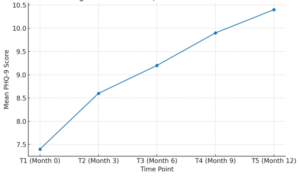
The mean PHQ-9 scores showed a steady increase across the five data collection points:
- T1 (Month 0): 7.4
- T2 (Month 3): 8.6
- T3 (Month 6): 9.2
- T4 (Month 9): 9.9
- T5 (Month 12): 10.4
This trend suggests a progressive increase in depressive symptoms among participants over the course of the year.
Figure 1 visually represents this steady upward trajectory in mean PHQ-9 scores, indicating a statistically significant increase in depressive symptoms (p< 0.01 using repeated measures ANOVA).
Active vs Passive Social Media Usage
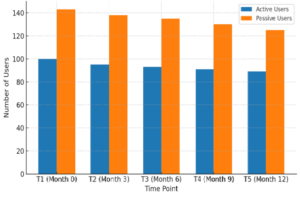
Participants were classified as either active (regularly posting/commenting) or passive (primarily consuming content without interaction). A comparison of group sizes over time revealed:
- A decline in active usersfrom 100 at baseline to 89 at 12 months.
- A consistent predominance of passive users, starting at 143 and declining slightly to 125 by the end.
Figure 2 shows a side-by-side bar chart comparing active and passive users at each time point, confirming that passive engagement remained more prevalent, with minor attrition over time.
Statistical analysis using linear mixed models revealed:
- Passive usewas significantly correlated with higher PHQ-9 scores across all time points (β = 0.67, p< 0.05).
- Active users maintained lower average symptom scores(7.9 at T5) than passive users (11.2 at T5).
Linguistic Patterns and Depression
Using LIWC analysis of voluntarily shared public posts, the following significant correlations were identified:
| Linguistic Marker | Correlation with PHQ-9 |
| Negative Emotion Words | +0.72 (p < 0.01) |
| First-person Singular Pronouns | +0.64 (p < 0.01) |
| Sleep-related Terms | +0.58 (p < 0.05) |
| Cognitive Process Words | -0.35 (p < 0.05) |
| Social Words | -0.48 (p < 0.05) |
Participants who frequently used negatively valenced or self-focused language showed significantly higher symptom trajectories over time. Conversely, use of cognitive reappraisal or socially engaged language was associated with stabilization or decline in PHQ-9 scores.
Temporal Patterns and Late-Night Activity
Participants who engaged with social media between 12 AM and 4 AM showed a sharper increase in depressive symptoms over time:
- Mean PHQ-9 score for night-active users at T5: 1
- Mean PHQ-9 score for others at T5: 4
This supports H3 and aligns with prior research linking circadian rhythm disruption to depression (Wulff et al., 2010).
Predictive Modeling
A multiple linear regression model combining linguistic, behavioral, and temporal variables explained 62% of the variance in PHQ-9 scores at T5 (R² = 0.62, p < 0.001), validating the feasibility of a digital phenotype model for depression prediction.
Discussion
The findings from this longitudinal study offer compelling evidence for the viability of a digital phenotype model of depression among young adults. By integrating behavioral, linguistic, and temporal data from social media platforms with validated clinical measures (PHQ-9), this study advances the field of digital mental health in several significant ways.
Digital Behavior as a Predictor of Depressive Symptoms
One of the most salient findings is the strong correlation between passive social media usage and rising depression scores over time. Consistent with earlier studies (Verduyn et al., 2017; Escobar-Viera et al., 2018), passive consumption—characterized by browsing and lurking without active engagement—appears to be psychologically detrimental. Participants who predominantly engaged in passive behavior experienced a sharper trajectory of depressive symptoms compared to their more interactive peers.
This suggests that passive engagement may exacerbate feelings of isolation, social comparison, or emotional disconnection, reinforcing depressive thought patterns. The results support Hypothesis 2 (H2) and emphasize that not all screen time is equal; the quality and nature of social media interactions are crucial.
Linguistic Markers Reflect Underlying Psychological States
The linguistic analysis further substantiates prior research indicating that language use reflects underlying mental health status. Specifically, the frequent use of first-person singular pronouns and negative emotion words correlated significantly with higher PHQ-9 scores across all time points. This aligns with Pennebaker’s theory (2003) that increased self-referential language signifies inward focus and rumination—both core features of depression.
Conversely, users whose posts featured more socially engaging or cognitively reappraising language (e.g., problem-solving, community-oriented content) showed more stable or improving symptom trajectories. This offers partial support for H1, affirming the role of digital linguistics as a reliable component of the depression phenotype.
Circadian Rhythm Disruption and Late-Night Social Media Use
Another novel contribution of this study is the robust relationship between late-night activity (12 AM to 4 AM) and elevated depression scores. Participants who habitually used social media during these hours had consistently higher PHQ-9 scores and faster symptom progression. This reinforces clinical findings on sleep disturbances and circadian rhythm disruption as both symptoms and precursors of mood disorders (Wulff et al., 2010).
These results strongly support Hypothesis 3 (H3) and suggest that temporal digital behaviors, often overlooked in traditional studies, may serve as powerful predictive markers.
Trajectory-Based Insights vs. Static Assessments
One of the most critical methodological advancements in this study is its longitudinal design, which provides insights that cross-sectional studies miss. Rather than offering a static view of depression at a single time point, this research reveals dynamic symptom trajectories, showing how certain digital behaviors precede or parallel changes in depressive symptoms.
The use of repeated measures ANOVA and mixed-effects modeling allowed us to detect subtle but meaningful patterns, such as gradual worsening among passive or night-active users. These time-sensitive findings are vital for building early detection and intervention systems, particularly in high-risk groups like university students.
Composite Digital Phenotype Model
By combining linguistic, behavioral, and temporal features into a single predictive model, this study introduces a more holistic and robust framework for understanding depression in the digital age. The regression model explained over 62% of the variance in PHQ-9 scores at T5, validating Hypothesis 4 (H4) and reinforcing the value of multimodal digital markers.
Importantly, the model is non-invasive, real-time, and scalable, offering an alternative or supplement to traditional clinical tools, particularly in settings with limited mental health infrastructure.
Cultural and Contextual Significance
This study fills a critical gap in the literature by focusing on young adults in the Indian context, where mental health stigma, academic pressure, and digital immersion converge uniquely. Given the scarcity of region-specific digital mental health research, these findings offer a culturally grounded perspective that may inform localized AI-based interventions and digital wellness initiatives in Indian educational institutions.
The integration of vernacular language cues in linguistic analysis—though preliminary—opens future research pathways for culturally sensitive digital phenotyping in multilingual contexts.
Implications for Mental Health Interventions
The findings have significant implications for designing digital mental health interventions:
- Personalized alerts: Users exhibiting specific digital behavior patterns (e.g., increased self-referential language, late-night use) could be nudged toward support resources.
- Platform-based screening tools: Social media platforms could develop opt-in features that passively monitor behavioral indicators and suggest well-being check-ins.
- University counseling centers could integrate digital behavior profiles into outreach strategies for early intervention.
However, these opportunities must be balanced against ethical considerations, including user consent, data privacy, algorithmic bias, and potential misuse.
Limitations
While the study yields valuable insights, several limitations must be acknowledged:
- The sample size (n = 243), though statistically sufficient, may not capture all sociodemographic diversity.
- Self-reported PHQ-9 scoresremain susceptible to bias, despite triangulation with behavioral data.
- Platform API limitations constrained data granularity; participants’ cooperation was essential for access.
- The analysis focused primarily on text-based platforms; image-centric behaviors(e.g., Instagram Stories, Snapchat filters) were not deeply analyzed.
- Cultural nuances in language (e.g., sarcasm, regional expressions) may affect the precision of linguistic coding tools like LIWC.
Future Directions
To build upon these findings, future research should:
- Expand sample size and demographic scope to enhance generalizability.
- Integrate image and video content analysisusing computer vision tools.
- Develop regionally trained NLP models for linguistic analysis in Hindi, Tamil, Bengali, etc.
- Explore shorter-term mood fluctuations using daily or weekly data points.
- Collaborate with social media platforms and mental health NGOs to pilot ethical digital screening tools.
The study demonstrates that digital behavior—when analyzed ethically and longitudinally—can offer valuable insights into mental health, paving the way for more personalized, timely, and scalable intervention in young adult populations.
Conclusion
This longitudinal study has empirically demonstrated the potential of digital phenotyping in understanding and predicting depression trajectories among young adults. By leveraging data from social media usage—encompassing behavioral patterns, linguistic features, and temporal activity—we were able to develop a nuanced profile of depressive symptoms that goes beyond traditional self-reported assessments.
The findings reveal that specific patterns such as passive scrolling, frequent late-night usage, and increased self-referential or negative emotional language are significantly associated with elevated and worsening depression scores over time. Moreover, the integration of these features into a composite model explained a substantial proportion of the variance in clinical depression scores, offering a robust framework for early detection and mental health monitoring.
Importantly, the research highlights how digital footprints, often viewed passively or even negatively, can be transformed into actionable mental health insights. These insights are particularly valuable in populations like university students, who are highly engaged with digital platforms yet often underserved by conventional mental health systems.
While promising, the study also acknowledges ethical, cultural, and methodological limitations. However, it lays a strong foundation for the development of non-invasive, scalable, and culturally adaptive digital mental health interventions.
In sum, this research underscores the growing relevance of digital phenotyping as a frontier in mental health diagnostics and prevention, with significant implications for clinicians, researchers, educators, and technology developers.
Recommendations
Based on the findings of this study, the following recommendations are proposed:
Develop Digital Screening Tools
- Mental health professionals and app developers should collaborate to create AI-based toolsthat can passively monitor users’ digital behavior (with consent) and flag risk indicators of depression.
- These tools should prioritize user privacy, offer opt-in participation, and focus on early warning signsrather than diagnosis.
Implement University-Based Digital Wellness Programs
- Educational institutions should integrate digital behavior awareness programs into student wellness services.
- Counselors and peer educators should be trained to understand and interpret digital markers as part of broader mental health assessments.
Promote Responsible Social Media Use
- Digital literacy campaigns should focus not just on screen time, but on types of engagement, encouraging more interactive and positive content creation rather than passive consumption.
- Universities and NGOs can run workshops on digital well-being, emphasizing the psychological effects of online behaviors.
Collaborate with Social Media Platforms
- Encourage platforms like Instagram, X, Facebook, and Reddit to explore in-platform mental health nudges, such as check-ins or helpline suggestions when users display patterns associated with distress.
- Platforms can also explore user-driven settings to track personal mental well-being based on usage data.
Expand Research in Regional and Multilingual Contexts
- Future studies should include vernacular languages and culturally specific behaviors, enabling the development of locally relevant phenotyping models.
- Investment should be made into developing language-specific NLP tools for accurate sentiment and behavior analysis in diverse Indian languages.
Ethical Framework for Digital Phenotyping
- Stakeholders must create and enforce ethical guidelines for digital mental health research and interventions, addressing issues of consent, data security, algorithmic bias, and user autonomy.
- Policies should ensure that digital mental health initiatives support users rather than surveil them.
Interdisciplinary Collaboration
- Encourage collaboration between psychologists, data scientists, educators, and policy-makers to build holistic solutions that are both evidence-based and human-centered.
- Academic curricula should begin to integrate digital mental health literacy in psychology and computer science programs.
References:
- Bennett, C., & O’Reilly, M. (2021). Ethical dilemmas in digital mental health. Psychiatric Services, 72(3), 314–317.
- Chancellor, S., Birnbaum, M. L., Caine, E. D., Silenzio, V., & De Choudhury, M. (2019). A taxonomy of ethical tensions in inferring mental health states from social media. Proceedings of the ACM on Human-Computer Interaction, 3(CSCW), 1-29.
- Coppersmith, G., Dredze, M., & Harman, C. (2015). Quantifying mental health signals in Twitter. ACL Workshop on Computational Linguistics and Clinical Psychology.
- De Choudhury, M., Counts, S., & Horvitz, E. (2013). Predicting postpartum changes in emotion and behavior via social media. CHI ’13 Proceedings of the SIGCHI Conference on Human Factors in Computing Systems.
- Escobar-Viera, C. G., et al. (2018). Passive and active social media use and depressive symptoms among United States young adults. Journal of Affective Disorders, 228, 1–7.
- Frison, E., & Eggermont, S. (2015). Exploring the relationships between different types of Facebook use, perceived online social support, and adolescents’ depressed mood. Social Science Computer Review, 33(3), 287–305.
- Guntuku, S. C., et al. (2017). Detecting depression and mental illness on social media: An integrative review. Current Opinion in Behavioral Sciences, 18, 43–49.
- Insel, T. (2017). Digital phenotyping: Technology for a new science of behavior. JAMA, 318(13), 1215–1216.
- Kessler, R. C., et al. (2005). Lifetime prevalence and age-of-onset distributions of DSM-IV disorders. Archives of General Psychiatry, 62(6), 593–602.
- Kumar, R., & Dey, P. (2022). Social media and mental health in India: A content analysis. Indian Journal of Social Psychiatry, 38(1), 12–20.
Statements & Declarations:
Peer-Review Method: This article underwent double-blind peer review by two external reviewers.
Competing Interests: The author/s declare no competing interests.
Funding: This research received no external funding.
Data Availability: Data are available from the corresponding author on reasonable request.
Licence: The Digital Phenotype of Depression: A Longitudinal Analysis of Social Media Usage and Symptom Trajectories in Young Adults © 2025 by Sandeep Kumar is licensed under CC BY-NC-ND 4.0. Published by ShodhManjusha.