
 Share
Share
Abstract
This study investigates the media consumption patterns of Haryana students residing outside the state. Limited existing research on this specific topic within Haryana necessitated an exploratory research design. The study focused on students from Jamia Milia Islamia, Jawaharlal Nehru University, Delhi University, and Guru Gobind Indraprastha University, ensuring representation from all three regions of Haryana and maintaining gender balance based on the state’s female literacy rate. Data was collected through surveys, and respondent feedback was considered. Findings indicate a significant shift in media habits among these students. While newspapers remain a primary source for detailed news, internet usage has become pervasive for information, communication, and entertainment. This presents a unique opportunity for the development of new media in Haryana, given the enthusiastic adoption by its younger generation despite limited internet access within the state.
Keywords: media, communication, female literacy, younger generation.
Introduction
Haryana has consistently been in the news, yet its media industry remains underdeveloped. Historically, policies in the state have often prioritized information control, potentially hindering progress. Limited communication tools have contributed to the state’s backwardness. The state’s geography further complicates matters.The absence of private channels, public relations firms, and privatization has stifled media growth (Mattelart, 2005). Newspapers remain the primary source of information in urban areas, while radio dominates rural areas.
A significant challenge is the limited availability of higher education institutions within the state. Many students pursue higher studies elsewhere, where they acquire new media habits (McHaney, 2023). These students, often the future leaders, act as conduits for introducing new media technologies and consumption patterns back to Haryana. Understanding the media consumption habits of Haryana students studying outside the state is crucial for predicting the future of media within the state. This research is particularly valuable as media surveys in Haryana have been limited.
Haryana, known for its picturesque landscapes, has recently experienced significant political instability. Technological advancements, particularly the rise of the internet in the 1990s, have revolutionized media consumption, leading to increased diversity in audience demographics (Gupta, 1999.). Growing literacy, rising living standards, and increased consumer spending have fueled the growth of various media platforms, including newspapers, radio, and television (Sharma,55). Since the 2000s, the internet and mobile phones have become increasingly important. However, access to media technology remains uneven across different regions of the state, with urban areas generally having better access than rural and remote areas.
Similar to the northeastern states, Haryana has faced challenges due to its geography and historical factors, including political instability and external influences. To assess the impact of national and international media on these regions, the Indian Institute of Mass Communication conducted a media survey focusing on local and national newspapers, All India Radio, Doordarshan, and some foreign channels like Pakistan Television and Bangladesh Television (Jalarajan, 2023).
This study examined media choices, program preferences, and cultural influences. A survey of 2000 respondents was conducted across three regions of Haryana, encompassing urban and rural areas. Research methods included questionnaires and in-depth interviews.
Findings revealed that 39.1% of respondents were exposed to various media, including radio, television, and particularly Pakistani television (PTV). Men (52.2%) exhibited higher media consumption rates than women (35.7%) for news.
Regarding cross-border media exposure, 44.5% of respondents in Haryana accessed it, compared to 11.5% in Jammu. Television was the primary source, with 59% accessing Pakistani channels, followed by QTV (46%), Aljazeera (9%), and Peace TV (11%). Visual clarity and good reception were cited as the most important factors for accessing cross-border media (15.7%). In Srinagar, cultural similarity was a key driver.
National media generally provided more up-to-date information than foreign media, while international internet sites offered greater information depth than national websites. Cable connections were more prevalent than Direct-to-Home (DTH) services. Overall, media access was significant, although men exhibited higher consumption rates than women, likely due to higher male literacy rates.
Education plays a significant role in media consumption patterns. Higher levels of education are generally associated with increased media usage (Chacko, 2001). This is reflected in the higher rates of media consumption observed among urban youth. In contrast, radio remains a popular medium in rural areas. Lower-income groups tend to favor radio, while higher-income groups often prefer television.
Aims and Objectives:
Objective 1: To understand the media consumption patterns of Haryana’s youth, which will inform future media planning within the state and at the national level.
Objective 2: To analyze how media consumption changes over time and when individuals relocate to different states.
Objective 3: To investigate the impact of international and cross-border media on the youth of Haryana, particularly those residing in border regions.
Hypothesis:
- Newspaper Consumption: Newspapers are primarily consumed in urban areas with readily available transportation.
- Radio Usage in Rural Areas: Radio serves as the primary source of information for rural populations.
- Impact of Cross-Border Media: Cross-border media channels significantly influence the media consumption habits of individuals, particularly among students who have left the state.
Research Design:
This study employed an exploratory and descriptive research design. The exploratory component aimed to investigate new theories and gain comprehensive insights, while the descriptive component provided a detailed account of a specific segment of youth within society.
Area of Research:
This research focuses on students residing in the vicinity of educational institutions in Delhi, including Jamia Millia University, Delhi University, Jawaharlal Nehru University, Guru Gobind Singh Indraprastha University, and other colleges within the city.
Selection of Sample:
This study employed purposive sampling to select 100 respondents from various universities and colleges in Delhi. The sample included students from all three regions of Haryana, with a deliberate effort to maintain a gender balance that reflects the state’s male and female literacy rates.
Research Methodology and Tool:
This research utilized a survey method to collect data. A structured schedule was developed containing a series of questions. Data was gathered through face-to-face interviews, where the researcher asked questions directly to respondents and recorded their answers on the schedule. Respondent reactions were also observed and documented. This empirical study relied on direct observation and personal experience to gather information.
Tabulation and Analysis of Data:
1- What comes to your mind immediately when you hear the word ‘media’?
- Newspaper
- Television
- Radio
- Film
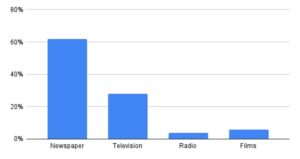
Figure 1
When asked to identify the first thing that comes to mind when hearing the term “media,” 62% of respondents cited newspapers, 28% mentioned television, 6% identified films, and only 4% responded with radio. This finding suggests that print media continues to hold a significant presence in the minds of young people, even in today’s era of media convergence.
2- Do you think that media is important for the individual as well as for the development of the nation?
- Is important
- Not important
- Important to some extent
- Extremely important
| A | B | C | D | |
| Media for individual | 92% | 2% | 5% | 1% |
| Media for nation | 90% | 3% | 6% | 1% |
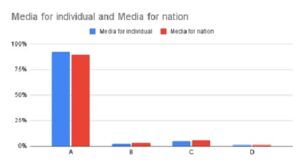
Figure 2
- How many hours a day you spent on watching Television?
- One hour
- Two hours
- Three or more
- I don’t watch TV
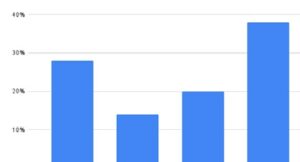
Figure 3
The study inquired about daily television viewing habits. 28% of respondents reported watching TV for an hour, 14% for two hours, and 28% for three or more hours. Notably, 38% of respondents in Delhi indicated they did not watch television. This was primarily attributed to a significant portion of young people residing in hostels or rented accommodations, often lacking access to televisions due to affordability constraints and limited availability in hostels. Furthermore, the increasing utilization of computers for various purposes, including internet access, was cited as a factor influencing the preference for laptops over separate television sets.
- Do you listen to Radio despite its visual limitations?
- Yes
- No
- Some Times
- It is no more attractive
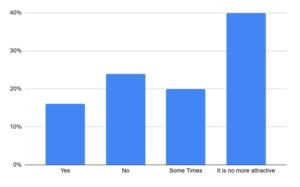
Figure 4
Respondents were asked about their radio listening habits, despite its visual limitations. 16% indicated they listen to radio regularly, 24% stated they never listen, 20% reported occasional listening, and 40% perceived radio as no longer appealing. The primary reasons cited for not listening to radio included a lack of entertaining content and perceived poor program quality.
- Which radio channels you mostly listen to?
- AIR (AM)
- FM channels
- Cross border stations
- International like BBC, VOA
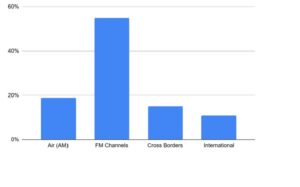
Figure 5
Regarding preferred radio channels, 19% of respondents indicated listening to All India Radio (AIR), while 55% favored FM stations. 15% reported listening to cross-border stations, and 11% mentioned international channels such as BBC and VOA. These findings suggest a resurgence in radio popularity among young people, primarily driven by the appeal of FM stations. This highlights the potential for expanding FM radio services to cater to the preferences of youth audiences.
- Have you ever subscribed to a newspaper or you read it outside?
- Yes
- No
- I don’t read newspaper
- I read it outside
Figure 6
A significant majority (82%) of respondents reported subscribing to a newspaper or reading it elsewhere. 10% indicated they do not subscribe but read newspapers occasionally. Notably, no respondent reported never reading a newspaper. These findings suggest that newspapers continue to exert a strong influence on young people, with many developing a daily habit of reading them for detailed information.
- Which media do you prefer when you have to know what is happening in your state?
- Television
- Internet
- Radio
- Newspaper
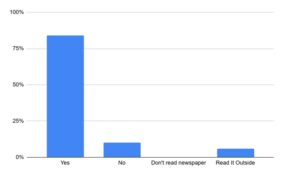
Figure 7
When asked about their preferred source for obtaining state-level news, 14% of respondents chose television, 62% selected the internet, and 24% opted for newspapers. No respondent indicated using radio for this purpose. These findings further emphasize the significant role of the internet as a primary source of information for young people.
- Do you think there is any change in media habits since you left your state?
- No change
- Slight change
- Drastic
- Never thought
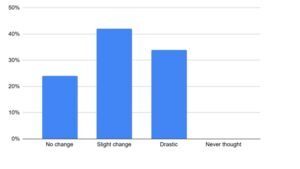
Figure 8
When asked about their radio listening habits, 24% of respondents indicated they listen to radio regularly, 42% reported occasional listening, and no respondent stated that radio is no longer appealing. These findings suggest that radio continues to hold some level of popularity among the youth.
- Do you think that cross border media of other countries like GEO TV, PTV, QTV are more credible when it comes to your state news as compared to our country’s own media?
- It is
- It is not
- Better than ours
- Shows news the way they want
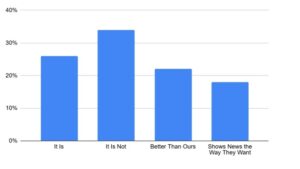
Figure 9
Respondents were asked to compare the credibility of cross-border media with their own country’s media. 26% believed cross-border media to be more credible, while 34% disagreed. 22% strongly asserted that cross-border media is significantly more credible, and 18% perceived cross-border media as presenting biased news coverage. These findings highlight the substantial influence of cross-border media on the youth.
- Are you more comfortable with international channels like BBC and Aljazeera than our countries own news channels?
- Yes I am
- No ours are better
- Communication Barriers
- sometimes they are good
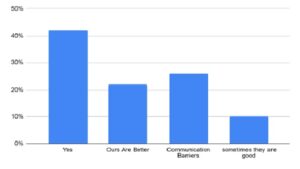
Figure 10
Respondents were asked about their preference between international news channels and their country’s own news channels. 42% expressed a preference for international channels, while 22% favored their country’s channels. 26% cited communication barriers as a factor, and 10% indicated that their preference varied depending on the situation. These findings suggest a significant influence of international media on the youth.
- Do you think that there is any change in media habits since you left your state?
- No change
- Slight change
- Drastic
- Never thought
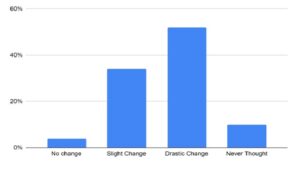
Figure 11
When asked about changes in their media habits since leaving the state, 4% of respondents reported no change, 34% observed slight changes, and 52% indicated significant shifts in their media consumption patterns. Approximately 10% of respondents did not consider this aspect.
- Have you ever subscribed to the value-added services on your mobile phone?
- Yes
- No
- Once
- Usually Do
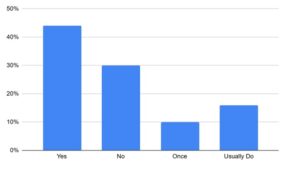
Figure 12
When surveyed about mobile value-added service subscriptions, 44% of respondents indicated they currently subscribe, 30% reported never subscribing, 10% stated they subscribed once, and 16% indicated they typically subscribe. These findings suggest a gradual increase in the adoption of mobile value-added services.
- How do you find mobile as a media option;does it serve your purpose?
- It is good
- It is irritating
- It is the future
- It is supplementary
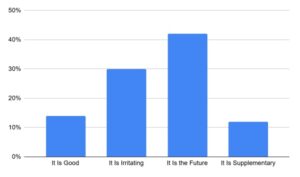
Figure 13
Respondents were asked to evaluate mobile phones as a media option. 14% considered them good, 30% found them irritating, 42% viewed them as the future of media, and 12% considered them supplementary. While some respondents expressed irritation due to value-added services and unsolicited subscriptions, the majority recognized the significant potential of mobile phones as a media platform. These findings indicate mixed perceptions of mobile phones as a media option, with some users experiencing frustrations related to certain features.
- Which online media links you mostly prefer to open on internet?
- E paper sites
- News channels sites
- Google information
- No media links
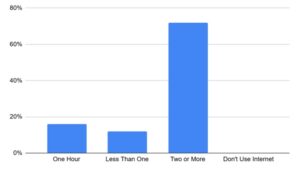
Figure 14
When asked about their preferred online media links, 24% of respondents cited e-paper sites, 8% selected news channel websites, 60% chose Google, and 8% indicated they do not typically access online media links. Respondents viewed Google as a primary source of information, while e-paper sites were valued for their valuable content. News channel websites were less popular, attributed to slow loading times due to poor internet connectivity and the time required to load visual content. The category of individuals who do not access online media links primarily consists of those who primarily utilize social networking sites.
- Most of the News channels are in Hindi, do you find any communication barrier with Hindi?
- Yes
- No
- Somt. it’s hard to understand
- I switch to other language
Figure 15
When asked about potential communication barriers due to the predominance of Hindi in broadcast channels, 20% of respondents acknowledged difficulties, 56% reported no issues, 6% indicated occasional comprehension challenges, and 18% stated they switch to other language options. English serves as the primary language of communication in the state. A study by the Times of India identified Haryana as the state with the highest youth adoption rate of English.
- Which was the last movie that was shot in Haryana?
- Dum Maaro Dum
- 7Khoon Maaf
- Faltu
- None of the Above
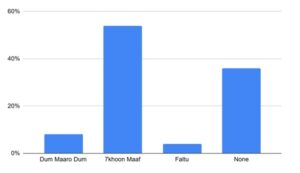
Figure 16
When asked to identify the most recent film shot in Kashmir, 8% of respondents answered “Dum Maaro Dum,” 54% responded with “7 KhoonMaaf,” 4% chose “Faltu,” and 36% were unable to recall any recent films. This suggests a significant level of film engagement among the youth.
- Which media according to you affect your lives the most?
- TV
- Films
- Internet
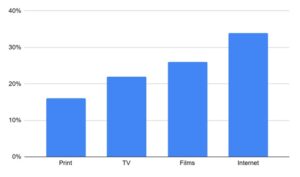
Figure 17
When asked about the media with the greatest impact on their lives, 16% of respondents cited print media, 22% chose television, 26% selected films, and 34% considered the internet to have the most significant influence. The findings highlight the internet’s considerable impact on individuals’ lives. Notably, a significant portion of youth recognize the influence of films, considering them an important and effective medium. This suggests a strong potential for the film industry within the state in the future.
- Have you subscribed for any magazine?
- Yes
- No
- Read it outside
- News papers are enough
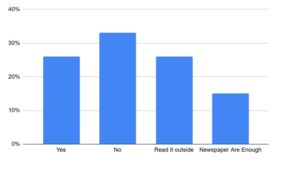
Figure 18
When asked about magazine subscriptions, 26% of respondents indicated they subscribe to magazines, 33% reported no subscriptions, 26% read magazines elsewhere, and 15% stated that newspapers provide sufficient information. While magazines remain popular among a significant portion of the population, their popularity among youth may be declining due to a perceived lack of magazines specifically addressing state-level issues. 15% of respondents believe that newspapers adequately cover their information needs, rendering magazine subscriptions unnecessary.
Conclusion
The study of Haryana students residing outside the state highlights a dynamic media environment where the internet plays a central role. While traditional media like television and newspapers remain relevant, the internet has become the primary platform for news consumption, entertainment, and social interaction. The study underscores the significant influence of cross-border media, particularly from neighboring countries, on how students perceive news and current events. Addressing the challenges and opportunities presented by this evolving media landscape necessitates the development of more diverse and credible media options, the implementation of media literacy programs, and the promotion of responsible journalism. Understanding these media consumption trends is vital for policymakers, media organizations, and advertisers to effectively engage with this student population.
References:
- Chacko, Priya. “Culture and politics in an age of global media: the impact of satellite television and the internet in India.” Flinders Journal of History and Politics 22.2001-2002 (2001): 110-123.
- Gupta, V. S. Communication technology, media policy, and national development. Concept Publishing Company, 1999.
- Jalarajan, Raj Sony, and Adith K. Suresh. “INDIAN TELEVISION AND THE RISE OF THE LOCAL.” Television Publics in South Asia: Mediated Politics and Culture (2023).
- Mattelart, Armand. Advertising international: The privatisation of public space. Routledge, 2005.
- McHaney, Roger. The new digital shoreline: How Web 2.0 and millennials are revolutionizing higher education. Taylor & Francis, 2023.
- Yadav, D. (2024). Reconditioning Indian Values in Learners Through Teachers, Parents & Society. Shodh Sari-An International Multidisciplinary Journal, 03(04), 321–326. https://doi.org/10.59231/sari7765
Sehgal, R., & Kaur, A. (2024). Fostering Student Success: The synergistic effects of family climate and school environment. Shodh Sari-An International Multidisciplinary Journal, 03(03), 203–209. https://doi.org/10.59231/sari7728
Statements & Declarations:
Peer-Review Method: This article underwent double-blind peer review by two external reviewers.
Competing Interests: The author/s declare no competing interests.
Funding: This research received no external funding.
Data Availability: Data are available from the corresponding author on reasonable request.
Licence: Media Consumption and Preferences of Haryana Students Studying in Delhi © 2025 by Sumedha & Manoj is licensed under CC BY-NC-ND 4.0. Published by ShodhManjusha.
Ethical Statement: The study involved the participation of minors. Prior permission was obtained from educational authorities, and informed consent was secured from parents/guardians. The research was conducted following ethical guidelines for research involving children, ensuring confidentiality, voluntary participation, and protection of participants from any harm.