
 Share
Share
Abstract
India’s commitment to sustainable development and climate action has brought renewable energy to the forefront of its national agenda. As one of the world’s fastest-growing economies with rising energy demands, India faces the dual challenge of ensuring energy security while minimizing environmental degradation. This review paper critically examines how the integration of renewable energy sources—such as solar, wind, hydro, and biomass—contributes to the achievement of key Sustainable Development Goals (SDGs), particularly SDG 7 (Affordable and Clean Energy), SDG 13 (Climate Action), and SDG 8 (Decent Work and Economic Growth). The paper synthesizes existing literature, government policy frameworks, and case studies to explore the role of renewable energy in reducing carbon emissions, enhancing energy access in rural and underserved regions, creating green jobs, and promoting inclusive economic development. It also highlights the technological advancements, policy initiatives like the National Solar Mission, and international collaborations that have accelerated India’s renewable transition. Despite notable progress, the paper identifies significant challenges such as grid integration issues, financing barriers, policy inconsistency, and socio-environmental impacts. These barriers, if unaddressed, may hinder the long-term alignment of renewable energy initiatives with SDG targets. The review concludes that while renewable energy integration has made measurable contributions to India’s SDG progress, a coordinated, interdisciplinary approach—combining innovation, policy reform, and community engagement—is essential for maximizing its impact. The findings offer strategic insights for policymakers, researchers, and energy planners aiming to build a sustainable, equitable, and resilient energy future for India.
Keywords: Renewable energy; integration; sustainable development
INTRODUCTION
India, characterized by its swiftly advancing economy and increasing population, confronts significant problems in satisfying its rising energy demand while maintaining environmental sustainability and energy security. India, being one of the largest and rapidly expanding economies globally, has experienced a consistent rise in energy demands due to industrialization, urbanization, and improving living standards. This increase in energy consumption has intensified apprehensions over energy availability, energy security, and environmental damage, especially in relation to climate change. In light of these issues, India has progressively adopted renewable energy sources as a fundamental aspect of its energy policy. Renewable energy, especially solar and wind power, has become an essential instrument in India’s quest for sustainable development goals (SDGs), providing solutions to alleviate climate change, improve energy security, and foster economic growth (Bassey, 2023).
Coal, oil, and natural gas are the primary components of electricity generation, which accounts for one-third of global greenhouse gas emissions. Enhancing access to cleaner, more dependable energy is essential for elevating living standards. To fulfill its present economic growth objectives, India is encountering an increasing demand for energy. The economic advancement of a nation depends on its capacity to supply growing amounts of energy (Bassey, 2024). A detailed 10-year action plan to supply energy nationwide has been prepared and is included in the National energy Plan established by the Ministry of Power (MoP). A distinct plan has been formulated to ensure the efficient and cost-effective provision of power to residents. India is ranked fourth in the World Resource Institute Report 2017 for total carbon emissions, behind China (26.83%), the USA (14.36%), and the EU (9.66%). Climate change might potentially disrupt the global ecological equilibrium. The Paris Agreement and the UNFCCC have received submissions of intended nationally determined contributions (INDCs). This latter seeks to limit the rise in global temperature to much below 2 °C. The World Energy Council estimates that global power demand will reach its peak in 2030. India, a major global user of coal, imports this costly fossil fuel. Coal and oil provide around 74% of the required energy (Babu, 2022; Kabel, 2020). A Center for Monitoring Indian Economy report indicates that India imported 171 million tons of coal in 2013–2014, 215 million tons in 2014–2015, 207 million tons in 2015– 2016, 195 million tons in 2016–2017, and 213 million tons in 2017–2018. Consequently, the identification of alternative electrical generation sources is imperative.
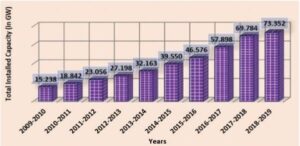
Source: Ministry of New and Renewable Energy Annual Reports May 2019
Fig. 1: Growth of renewable energy over the past decade in India
Research objectives: To critically examine how the integration of renewable energy sources contributes to the achievement of key Sustainable Development Goals (SDGs) in India.
- Conceptual Understanding of Renewable Energy and SDGS
- Definition and Types of Renewable Energy Sources
Renewable energy denotes energy obtained from natural processes that are perpetually renewed. In contrast to fossil fuels, renewable sources are sustainable and possess a markedly reduced environmental effect. These sources are inexhaustible and are essential for reducing greenhouse gas emissions (Bassey, 2023).
- Main types of renewable energy sources
- Solar Energy: Captured from sunlight using photovoltaic panels or solar thermal collectors.
- Wind Energy: Generated using wind turbines that convert wind kinetic energy into electricity.
- Hydropower: Produced by harnessing the energy of flowing or falling water, usually through dams.
- Biomass Energy: Derived from organic matter like agricultural waste, forest residues, or animal dung, often used for heat or electricity.
- Geothermal Energy: Obtained from the Earth’s internal heat, especially in volcanic or tectonically active regions.
- Tidal and Wave Energy: Sourced from ocean tides and wave movements, though still in early stages in India.
- Linkages between Renewable Energy and Specific SDGs
Renewable energy is directly or indirectly linked to multiple Sustainable Development Goals (SDGs). Key connections include:
- SDG 7 – Affordable and Clean Energy: Promotes access to reliable, sustainable, and modern energy for all. Renewable energy is central to this goal.
- SDG 13 – Climate Action: Reducing carbon emissions through renewable energy helps combat climate change.
- SDG 8 – Decent Work and Economic Growth: The renewable energy sector creates green jobs, boosts rural livelihoods, and stimulates sustainable economic growth.
- SDG 9 – Industry, Innovation and Infrastructure: Encourages investment in clean energy technologies and smart infrastructure.
- SDG 11 – Sustainable Cities and Communities: Urban renewable energy solutions reduce pollution and promote energy-efficient cities.
- SDG 3 – Good Health and Well-being: Reducing air pollution through clean energy improves public health outcomes.
- Role of Clean Energy in Sustainable Development
Clean energy is essential for attaining sustainable development by providing an ecologically sustainable, economically feasible, and socially inclusive avenue for advancement. In contrast to fossil fuels, renewable energy sources—such as solar, wind, hydro, and biomass—generate negligible greenhouse gas emissions and contribute to alleviating the impacts of climate change. They mitigate environmental deterioration by decreasing air and water pollutants, conserving habitats, and enhancing climate resilience. The renewable energy industry generates jobs, fosters local entrepreneurship, and decreases long-term energy expenses, particularly for rural and marginalized people (Baylen, 2020). It facilitates energy autonomy, which is essential for national energy security and economic stability. Clean energy fosters social equality by enhancing energy accessibility in distant regions, improving health outcomes via less pollution, and empowering underprivileged communities through inclusive energy initiatives. In India, where millions remain without dependable electricity and environmental issues are escalating, the integration of clean energy is crucial not only for satisfying energy demand but also for conforming to the Sustainable Development Goals (SDGs), specifically those pertaining to clean energy (SDG 7), climate action (SDG 13), and poverty alleviation (SDG
- Consequently, clean energy serves as a fundamental element of a future that is environmentally sustainable, inclusive, and green (Bishoge, 2020).
Challenges in Renewable Energy Integration
While renewable energy presents a promising path toward sustainable development and energy security, its integration into existing energy systems is fraught with significant challenges. One of the primary issues is the intermittent and variable nature of sources like solar and wind. Since these depend on weather and time of day, ensuring a constant and reliable power supply becomes complex without adequate storage technologies or backup systems. Another major challenge is grid infrastructure. India’s power grid was initially designed for centralized fossil-fuel-based generation (Jain, 2022). Integrating decentralized and fluctuating renewable energy inputs often causes transmission bottlenecks, voltage instability, and increased grid management complexity. Upgrading infrastructure to support smart grids and flexible demand response systems requires high capital investment and time.
Financing and investment barriers also hinder renewable expansion, particularly for small and medium enterprises and rural cooperatives. Although the cost of technologies like solar panels has declined, initial setup costs, lack of access to credit, and investor hesitation in long-gestation projects remain key obstacles. Moreover, policy and regulatory inconsistencies across states create confusion and discourage long-term private sector participation. Delays in power purchase agreements, lack of timely subsidies, and bureaucratic hurdles affect project implementation and investor confidence (Apfel, 2022).
From a social and environmental perspective, land acquisition for large-scale renewable projects often leads to displacement and ecological degradation, especially in forested or tribal areas. Additionally, the lack of skilled manpower and digital literacy limits the effective operation and maintenance of advanced renewable systems (Asiaban et al. 2021). While India’s renewable energy sector has made substantial progress, overcoming these challenges through coordinated policy reforms, technological innovation, and public-private collaboration is essential to fully realize its potential and align with sustainable development goals.
Conclusion
The incorporation of renewable energy sources into India’s energy framework represents not just a technological and economic transition, but also a pivotal advancement toward realizing the overarching objectives of sustainable development. This review paper rigorously analysed the direct and indirect contributions of renewable energy to the achievement of various Sustainable Development Goals (SDGs), emphasizing SDG 7 (Affordable and Clean Energy), SDG 13 (Climate Action), SDG 8 (Decent Work and Economic Growth), SDG 9 (Industry, Innovation, and Infrastructure), and SDG 11 (Sustainable Cities and Communities).
India, as a swiftly advancing nation with escalating energy requirements, has achieved notable progress in augmenting its renewable energy capability, especially in solar and wind energy. The government has evidenced its dedication to transitioning to a low-carbon economy through projects like the National Solar Mission, International Solar Alliance, and state-level renewable energy regulations. These initiatives have not only diminished greenhouse gas emissions but also enhanced energy accessibility in rural and underserved regions, improved air quality, and generated employment possibilities in the green energy sector.
Nonetheless, the transfer has encountered some hurdles. The sporadic availability of renewable resources, deficiencies in grid infrastructure, budgetary limits, land procurement challenges, and policy discrepancies persist in obstructing the comprehensive integration of renewables. The disparate allocation of renewable projects among states, coupled with differing implementation capacities, underscores the necessity for a more decentralized and equitable energy strategy.
Notwithstanding these obstacles, it is evident that renewable energy is pivotal in harmonizing economic progress with environmental sustainability. The shift to clean energy not only facilitates climate action but also bolsters national energy security, diminishes reliance on fossil fuel imports, and empowers local communities via decentralized power generation and employment development.
To enhance the influence of renewable energy integration on attaining the Sustainable Development Goals, many strategic initiatives are necessary. This encompasses the enhancement of smart grid infrastructure, the advancement of efficient energy storage technologies, the streamlining of regulatory processes, and the augmentation of financial assistance via green finance methods. Moreover, it is essential to promote capacity-building initiatives, public-private collaborations, and locally renewable solutions to guarantee community engagement and enduring sustainability.
Policy consistency between central and state governments, together with alignment with international climate agreements such as the Paris Agreement, will be essential for sustaining momentum and amplifying efforts countrywide. India must invest in research and innovation to tailor renewable technology to its varied geographic and socio-economic situations.
Renewable energy is not only a remedy for the energy issue; it is a significant catalyst for sustainable development. The incorporation of clean energy into India’s developmental framework has a distinctive chance to attain economic growth, social inclusion, and environmental preservation concurrently. Going forward, a comprehensive, multidisciplinary, and equity-focused strategy would be crucial to guarantee that renewable energy integration acts as a strong foundation in India’s pursuit of its Sustainable Development Goal commitments by 2030 and beyond.
References:
- Apfel, D. (2022). Renewable energy transition in Senegal? Exploring the dynamics of emerging paths to a sustainable energy system. Energy Research and Social Science, 92, Article 102771.
- Asiaban, S., Kayedpour, N., Samani, A. E., Bozalakov, D., De Kooning, J. D. M., Crevecoeur, G., & Vandevelde, L. (2021). Wind and solar intermittency and the associated integration challenges: A comprehensive review including the status in the Belgian power system. Energies, 14(9), 2630. https://doi.org/10.3390/en14092630
- Babu, S., Rathore, S. S., Singh, R., Kumar, S., Singh, V. K., Yadav, S. K., Yadav, V., & Raj.
- Babu, S., Singh Rathore, S., Singh, R., Kumar, S., Singh, V. K., Yadav, S. K., Yadav, V., Raj, R., Yadav, D., Shekhawat, K., & Ali Wani, O. (2022). Exploring agricultural waste biomass for energy, food and feed production and pollution mitigation: A review. Bioresource Technology, 360, Article 127566. https://doi.org/10.1016/j.biortech.2022.127566
- Bassey, K. E. (2023a). Hybrid renewable energy systems modeling. Engineering Science & Technology Journal, 4(6), 571–588.
- Bassey, K. E. (2023b). Hydrokinetic energy devices: Studying devices that generate power from flowing water without dams. Engineering Science & Technology Journal, 4(2), 1–17.
- Bassey, K. E. (2023c). Solar energy forecasting with deep learning technique. Engineering Science & Technology Journal, 4(2), 18–32
- Bassey, K. E., & Ibegbulam, C. (2023). Machine learning for green hydrogen production. Computer Science & IT Research Journal, 4(3), 368–385. https://doi.org/10.51594/csitrj.v4i3.1253
- Bassey, K. E., Opoku-Boateng, J., Antwi, B. O., & Ntiakoh, A. (2024). Economic impact of digital twins on renewable energy investments. Engineering Science & Technology Journal, 5(7), 2232–2247.
- Bayulgen, O. (2020). Localizing the energy transition: Town-level political and socio- economic drivers of clean energy in the United States. Energy Research and Social Science, 62, Article 101376.
- Bishoge, O. K., Kombe, G. G., & Mvile, B. N. (2020). Renewable energy for sustainable development in sub-Saharan African countries: Challenges and way forward. Journal of Renewable and Sustainable Energy, 12(5).
- He, J., Yang, Y., Liao, Z., Xu, A., & Fang, K. (2022). Linking SDG 7 to assess the renewable energy footprint of nations by 2030. Applied Energy, 317, Article 119167.
- Husin, H., & Zaki, M. (2021). A critical review of the integration of renewable energy sources with various technologies. Protection and Control of Modern Power Systems, 6(1), 1–18.
- Jain, A., Sarsaiya, S., Awasthi, M. K., Singh, R., Rajput, R., Mishra, U. C., Chen, J., & Shi, J. (2022). Bioenergy and bio-products from bio-waste and its associated modern circular economy: Current research trends, challenges, and future outlooks. Fuel, 307, Article 121859.
- Jaiswal, K. K., Chowdhury, C. R., Yadav, D., Verma, R., Dutta, S., Jaiswal, K. S., & Karuppasamy, K. S. K. (2022). Renewable and sustainable clean energy development and impact on social, economic, and environmental health. Energy Nexus, 7, p.100118. International Journal of Engineering Research Updates, 2024, 07(02), 013–027 25
- Jayachandran, M., Gatla, R. K., Rao, K. P., Rao, G. S., Mohammed, S., Milyani, A. H., Azhari, A. A., Kalaiarasy, C., & Geetha, S. (2022). Challenges in achieving sustainable development goal 7: Affordable and clean energy in light of nascent technologies. Sustainable Energy Technologies and Assessments, 53, Article 102692.
- Kabel, T. S., & Bassim, M. (2020). Reasons for shifting and barriers to renewable energy: A literature review. International Journal of Energy Economics and Policy, 10(2), 89–94.
- Adebayo, O. A. (2024). The pinnacle impacts of the community policing as a pillar in sustaining global peace. Edumania-An International Multidisciplinary Journal, 02(02), 49–59. https://doi.org/10.59231/edumania/9037
- Olanipekun, O. O. (2025). The role of educational psychologists in promoting sustainable practices in urban schools: a case study of Lagos State, Nigeria. Edumania-An International Multidisciplinary Journal, 3(2), 120–134. https://doi.org/10.59231/edumania/9121
- Renshu, R., Juneja, P., & Meenakshi, M. (2024). Examining the role of soil in promoting sustainable development and achieving the UN Sustainable Development Goals (SDGs). Shodh Sari-An International Multidisciplinary Journal, 03(03), 265–285. https://doi.org/10.59231/sari7734
Statements & Declarations:
Peer-Review Method: This article underwent double-blind peer review by two external reviewers.
Competing Interests: The author/s declare no competing interests.
Funding: This research received no external funding.
Data Availability: Data are available from the corresponding author on reasonable request.
Licence: Renewable Energy Integration and its Role in Achieving Sustainable Development Goals (SDGS) In India © 2025 by Parul Sharma is licensed under CC BY-NC-ND 4.0. Published by ShodhManjusha.
Ethical Statement: This study involved human participants. All procedures were conducted in accordance with ethical standards of research involving human subjects. Informed consent was obtained from all participants before data collection. Participation was voluntary, anonymity and confidentiality of respondents were ensured, and no personally identifiable information was collected.