
 Share
Share
Abstract
The study focuses on the impacts of Civil Service Conflict Management Policy on employees’ job satisfaction. The paper assumes that having a permanent guide and process promotes peace and stability in organisations than ad-hoc arrangements. Also, that achieving higher job satisfaction is paramount to employees, and disagreements with the employer will be inevitable periodically. Hence, the need for a well agreed upon document between the employer and the employees in managing all emerging issues. Therefore, this paper examines the impacts of Lagos State Civil Service Conflict Management Policy, which is one of the administrative policies on Lagos State Local Government employees’ job satisfaction. This survey study adopts descriptive and inferential statistical tools to analyse the data collected from the questionnaires administered on 270 samples drawn randomly and purposefully among senior employees of 6 local governments, representing the 3 senatorial districts of Lagos State. The findings from the chi-square test of 3 hypotheses confirm all the 3 alternative hypotheses: that the policy document is suitable for its purpose, that the processes provided in the document are effective, and lastly, that the policy outcome impacts on employees’ job satisfaction. Thus, to strengthen the effectiveness of the policy in promoting industrial harmony and job satisfaction based on observed policy implications, this paper recommends periodic review of the conflict management policies, proactive resolution of disagreements with workers, the consideration of all available solutions in resolving disagreements, and where necessary, inviting third party intervention to ensure neutrality and building of confidence.
Keywords: Conflict management, policy, job satisfaction, job productivity, employees’ welfare.
Introduction
The expectation of any organization’s employee is to achieve job satisfaction by maximizing its welfare, while the organization also intends to optimally achieve higher performance by increasing organizational productivity. Employees achieve this by always making efforts to maximize their benefits through promotion and self-development, better pay, improved work environment, effective organisation communication, and enhanced organisation commitment. It is evident that in most cases, conflict is inevitable in the processes, hence, the need for a plan to manage the potential issues that can escalate into conflict.
Different organisations have different ways of managing the process. While some prefer ad-hoc, bigger organizations prefer permanent arrangements for efficiency and effectiveness, which is the reason for organisations’ conflict management policy. Determinants and rules guiding the policies vary from one organisation to another, but they are largely determined by the employment contractual agreement between the organisation and its employees as presented in the employees’ conditions of service.
Nigeria civil service is decentralized (Aderogba, 2023), hence the state and local government workforces are managed by the state civil service commission. Therefore, this study examines the effectiveness of conflict management policies in public service on job satisfaction of civil servants, using Lagos State Local Government Employees as a case study. Civil But the question for this research is: how suitable is this policy, how effective is the conflict management process as prescribed as a policy, and what is the impact of the policy output on employees’ job satisfaction in the local government service?
Thus, the objectives of this study are: to examine the suitability of the CMP in managing employees- employers disagreement in local governments; to evaluate the effectiveness of the conflict management processes as contained in the CMP; and to examine the effects of CMP on local government employees’ job satisfaction. The outline of the paper includes: Conceptual Review, Methodology, Results and Discussion, Policy Implications, and Recommendations.
Conceptual Review
Job Satisfaction
Job satisfaction is a positive emotional perception of the individual work and experiences. It refers to the individual level of contentment, comfortability, and fulfilment in their jobs. Job satisfaction is significant to organisation’s leadership and the decision-makers, because of its impacts on other essential aspect of the operations most especially, the employees productivity (Ali, 2016). It assists organisations in aligning with the employees values, understanding their motivation and engagement, measuring the impacts of employees’ perception of their jobs in organisational performance, and providing insights into changes required to improve overall productivity (Baxi & Atre, 2024).
Several models and theories in literature explain job satisfaction. Herzberg’s Two-Factor Theory (1959) divides workplace factors into two; hygiene factors like salary, company policies, and working conditions, and the other is motivators like, recognition, responsibility, and opportunities for growth on the job. According to Herzberg, the presence of hygiene factors may not achieve satisfaction, though, its absence can lead to dissatisfaction, and however, since motivators are intrinsic to the job, it creates satisfaction. On the other hand, the Job Characteristics Model emphasizes the effects of job features like skill variety, task identity; task significance, autonomy, and feedback on job satisfaction. The more the employees perceive their work as meaningful and receive feedback, the more likely they are satisfied (Hackman & Oldham, 1976)
Yilin (2023) identifies four organisational-level key factors with positive correlation to job satisfaction: work environment, salary and benefits, career development, and leadership style. This is not to deny the fact that the individual differences influence job satisfaction due to expectations and experiences.
Organisational Conflict
Organisational conflict is the outcome of individuals or groups perception of the actions of the management as conflicting or incompatible with their interest (Robbins & Judge, 2021). It refers to misunderstandings or disagreement among employees or members of an organisation, as a result of differences in terms of needs, interests, and values, and how each reacts to the issues differs. In the workplace, it occurs between authority and individuals or groups, concerning issues like revenue distribution, task execution, or working hours, jurisdictional conflict between departments, employees, management, and unions, or may be as trivial as rivalries, influence, and struggle for responsibilities or roles (Mohammed, 2017). Workplace conflict or organisational conflict occurs when disagreements or misunderstandings arise between individuals or groups within the same organisation due to differing needs, ideas, beliefs, values, or goals and improperly managed workplace conflict can harm individual and the organisation goals (Neupane, 2022). It is a common phenomenon, a complex and multifaceted concept. It can arise from different factors or combination of factors, differing goals and objectives, and as a consequence of ineffective communication.
Organisational conflicts have both positive and negative consequences. According to the Interactionists, conflicts can be functional or dysfunctional. Robbins (2001) posits that functional or constructive conflict benefits an organisation by facilitating healthy competition, hard work, and improving productivity. On the other hand, dysfunctional or destructive conflict hinders individual and organisational performances, constrains organisational goals, reduces productivity, and obstructs inter personal relationships. In most cases, employees and the organisation suffer the consequences of conflict-ridden work environment.
Conflict Management Policy
Management of Conflict for positive impact is essential in any organisation. It refers to the process, by which organisations handle conflicting interests from degenerating. It encompasses prevention and resolution to reduce negative consequences while maximising the positive impacts. Conflict management strategies include Integrative negotiation, which emphasizes mutual interests and win-win outcomes (Rubin, Pruitt, & Kim, 1994), and mediation or third-party intervention, which usually facilitate proper insight and communication for mutually acceptable resolutions (Deutsch, 1976 ).
However, policy refers to articulated set of principles or procedures guiding decisions to achieve rational outcomes, within organisations or governments ( Aderogba, 2022). Thus, public policy explains the intention or output of the government decisions (Warner, 2022).The stages of policy process include problem identification, agenda setting, policy formulation, decision-making, and implementation. A conflict management policy is an administrative framework that guides an organisation in identifying, treating, and resolving workplace disputes or disagreements. Its primary goal is for efficiency and fairness, to foster a productive work environment. Such policies usually define the processes or procedures, standard conducts and necessary resources. By providing detail guidelines, it promotes respect, enhances productivity and facilitates employee satisfaction (McGinley, 2017). Conflict management policy, which usually contains plan, structure and strategies, is inevitable in any organisation with diversity, interdependence and inclusivity for organisational performance (DeChurch, Mesmer-Magnus, & Doty, 2013). Conflict management policy that focuses on prevention than resolution; through open communication, negotiation, and collaboration is preferable for job satisfaction and organisational performance.
Effective management of conflict depends on understanding of nature of conflict and adopting peculiar right strategy, for instance, while task conflict relates to disagreements concerning work responsibilities, which functionally stimulates innovation and problem-solving, relationship conflict relates to disagreements concerning personal differences, which dysfunctionally undermines team cohesion and productivity (De Dreu and Beersma, 2005). However, the Dual-Concern Model proposes two primary dimensions to conflict management; concern for self and concern for others.
Conflict Management in Lagos State Public Service
Labour Act is the principal law that regulates the relationship between the employer and the employee in Nigeria. Employment could be in the public sector or private sector. Section 318 of the 1999 Constitution of the Federal Republic of Nigeria defined public service as service of the federation or of a state in any capacity mentioned under the said section. Private sector, on the other hand, is the part of the economic system of a country that is run by individuals and companies that are privately owned.
In every relationship, dispute cannot be ruled out. Therefore, employer and employee relationship is not immuned from potential dispute. Based on the provisions of sections 48 and 54 of the Trade Dispute Act (2004) Cap T14, Laws of the Federation of Nigeria, dispute essentially conveys the element of disagreement and such disagreement must involve a trade. Section 48 provides for elements that constitute dispute. It must involve a trade, between an employer and worker(s) or workers and workers and it must be connected with the employment or non – employment, or the terms of employment, or physical conditions of work of any person (Longe, 2019). Prior to 2006, magistrate court and or district court had the jurisdiction to settle labor related disputes while sections 80-85 cover the settlement of disputes under the Labor Act. Since 2006, the National Industrial Court is now clothed with the exclusive jurisdiction to hear matters relating to trade disputes and make award.
Every Public Service and the private sector have its own style of managing their internal conflicts. This is referred to as bargaining which is the process of negotiating an agreement on the basis of give and take (Enimola, 2008). However, the style each of them uses will have a tremendous impact on the outcome of a conflict and will determine whether it has negative or positive consequences (Igboeche, 2015). The TDA provides for legal mechanisms for solving disputes between parties. It accepts the principle of free collective bargaining and voluntary settlement of trade dispute as the basis of action under the Act. It is only where it fails, or where none is in place that the compulsory procedures are applied (Longe, 2019). Section 3 provides that the parties to a trade dispute are charged to first attempt to settle the dispute themselves in accordance with any standing agreement made by them for that purpose. Failure to reach a voluntary settlement, parties are expected to resort to mediation within seven days of the failure, meet together by themselves or their representative, under the chairmanship of a mediator that was mutually agreed upon and appointed by or on behalf of the parties with a view to the amicable settlement of the dispute. The mediator has seven days within which to amicably settle the dispute and where the mediation fails, a written report to the Minister of Employment.
The Minister may, based on the provisions of Section 7(1), appoint a conciliator to settle the parties. If a settlement of the dispute is reached within seven days of his appointment, the person appointed as conciliator shall report the fact to the Minister, and shall forward to him a memorandum of the terms of the settlement signed by the representatives of the parties which shall become binding on the parties. Where the Conciliator fails to settle the parties, a report will be made to the Minister who will refer the trade dispute to the Industrial Arbitration Panel (lAP) within 14 days of the receipt of the report. The Panel must make its award within twenty-one days of its constitution or such longer period as the Minister may in any particular case allow.
Where parties are not satisfied with amicable settlement methods stated above, recourse may be made to National Industrial Court. The National Industrial Court is a superior court of record and all intra-union disputes are now within its exclusive jurisdiction as affirmed in the case of F.C. Udoh & Ors v Orthopaedic Hospital Management Board &Ors (1993). All matters in relation to trade disputes end at the NIC except matters involving fundamental rights the parties.
Internal Dispute Resolution in Lagos State Public Service
Within the Lagos State Public Service, there are means of settling disputes arising internally between staff or provided for under the Lagos State Government Public Service Rules (2015) under chapter 10. Grievance is defined as an adverse situation inimical to the interest of an officer, which includes injustice, wrong, disservice, hurt, injury and so on. An aggrieved officer is expected to make a formal report which will be investigated by the relevant Personnel Management Board and decision taken. Where the officer is not satisfied with the decision of the board, a representation shall be made to the Permanent Secretary or the Head of Extra-Ministerial Department/Agency. Paragraph 100102 of the said Public Service Rules provides that if the officer is still not satisfied with the outcome of the Permanent Secretary or the Head of Extra-Ministerial Department/Agency, a formal written appeal is made.
In Lagos State University of Science and Technology, the Conditions of Service Guiding Senior Staff (2024) in its chapter five makes provisions for internal dispute resolutions. The Heads of Department, Deans and the Vice Chancellor can initiate or issue query. The Human Resources Directorate (HRD) is also empowered to initiate disciplinary processes but subject to the approval of the Registrar. The HRD shall look at the query and the response by the alleged staff and shall evaluate whether such response is in line with the matter. If the HRD is not satisfied with the response to the query, the matter shall be referred to the Staff Disciplinary Committee (SDC). The finding of the SDC shall be forwarded to the Appointments and Promotions Committee (APC) for consideration. The APC upon the consideration of the report sent to it shall make its recommendation and send same to the Governing Council for final approval. The Council shall upon the consideration of the recommendation of the APC uphold or upturn the recommendation. An officer has the right to make an appeal to the Council.
Alternative Dispute Resolution in Lagos State (ADR)
Mediation, an alternative dispute resolution (ADR) mechanism is the traditional way of resolving disputes peacefully in agrarian rural based in Nigeria. It was used as a device for conserving cultural norms and standards. Mediation disallowed disputes from decaying, maintained peace and preserved traditional values (Rhodes-Vivour, 2008). In the case of Okpuruwu vs. Okpokam(1998) observed that before the introduction of regular court, Nigerians have a simple way of settling disputes through the elders and still embed in the modern system.
Alternative dispute resolution are inspired and advanced by the Lagos State High Court Laws, the rules of court and the Lagos State Government. ADR continues to be a tool in Lagos State for the resolution of disputes in a good-natured manner at less cost usually on a win-win basis and with the benefit of face saving. It encourages the restoration of the relationship of the parties in a peaceful way devour of the intervention of court or tribunal. The Citizens’ Mediation Centre and Multi-Door Court House are the ADR institutions in Lagos State.
Lagos State Citizens’ Mediation Centre
The Lagos State Citizens Mediation Centre was created in 1999 under the Directorate of the Citizens Rights, Ministry of Justice of the Lagos State. It provides free alternative dispute resolution services to indigent members of the public to access justice. Any person or organisation may, by written petition or, walk-in to the centre to initiate mediation or it could also be a ‘referral’ from government agencies or by court order. The aims for the establishment of the centre are: provision of qualitative mediation through skilled mediators; timely management of disputes; accessibility to or by the public; and commitment to improvement service provision and responsiveness to public.
Multi-Door Court House
The Lagos Multi-door Courthouse system is an innovation intended at offering an institutional framework for the resolution of disputes through ADR arising from cases instituted directly in the court system or outside of it (walk-ins). On the 11th day of June 2004 the Chief Judge of Lagos State issued practice directions for the functioning of the Multi-Door Courthouse located within the court premises. The aims are to actively manage cases. Going by section 1 (1) (b), the court was required to refer cases to the Lagos Multi-Door Courthouse where the court considers ADR a worthwhile option. The Multi-Door Courthouse offers parties to a dispute various doors to disputes resolution, early neutral evaluation, arbitration and mediation.
Theoretical Framework (Organisational Justice Theory)
Organisational justice refers to individual justice judgments formed from the evaluation of the workplace events, actions, and decisions. These perceptions are expectedly subjective, and depend on the individuals involved; employees, supervisors, unions, management and interested third-party (Tyler, 2000). It focuses on workplace fair treatment and its effect on individuals’ attitudes and behaviours at work (Aderogba, & Aderogba, 2022). It has four aspects; distributive, procedural, interpersonal, and informational organisational justice (Wiseman & Stillwell, 2022). It is distributive when decision outcomes such as pay and promotions are fair, procedural when the processes, such as lack of bias and equitable representation are perceived as fair, informational when the information on the outcomes are adequate and transparent, and it is interpersonal when the quality of interpersonal engagement between the workers and representatives of the organisation such as politeness and dignifying treatment are seen as fair (Wiseman & Stillwell, 2022).
Perceived organisational distributive justice enhances job satisfaction and organisational commitment, while perceived unjust in outcomes leads to dissatisfaction, reduced productivity and withdrawal (Cropanzano & Molina, 2015). Perceived procedural fairness, impacts on organisational trust, and commitment (Thibaut & Walker, 1975). Also, satisfying interpersonal justice can reduce negative work behaviours and strengthen organisational communication (Bies & Moag, 1986). On the other hand, informational justice enhances transparent communication, trust in decision and reducing resentment (Greenberg, 1983).
Organisational justice affects not only organisational performance, but also determines the employee job satisfaction. Thus, organisational injustice has a great negative impact on the relationship between employer and employees and can lead to low productivity and negative consequences (Yean &Yusof, 2016), while positive perceptions of organisational justice can result to beneficial outcomes, including improved job performance, higher levels of trust, and reduced conflict (Wiseman & Stillwell, 2024).
CMP is one of the reliable recognised instrument of enabling fairness in various organisations and the extent to which it is effective and efficient will depend on how suitable the instrument is, how far the processes are, and finally, how impactful the outcomes are on employees job satisfaction, which is the main goal.
Hypotheses:
The following hypotheses are tested to examine the impacts of the policy on the Lagos State Local Government employees’ job satisfaction.
Ho1: the Public Service Conflict Management Policy is unsuitable in managing employees- employer industrial relation in Lagos State Local Governments.
H1: Public Service Conflict Management Policy is suitable in managing employees- employer industrial relation in Lagos State Local Governments.
Ho2: the policy process is ineffective in managing employees- employer industrial relation in Lagos State Local Governments.
H2: the policy process is effective in managing employees- employer industrial relation in Lagos State Local Governments.
Ho3: the policy has no effects on the local governments’ employees’ job satisfaction.
H3: the policy has effects on the local governments’ employees’ job satisfaction.
Methodology
The study adopts survey method, and the instrument is a structured questionnaire in liker format. The questions are grouped into three sections; Section A asks questions relating to the suitability of the policy, Section B asks questions relating to the effectiveness of the policy process, while Section C asks questions relating to the effect of the policy output on the employees’ job satisfaction. The population of the study is the local government employees in Lagos State, while the sample is 270 respondents selected through random technique from 6 local governments chosen for convenience; two representing each of the three senatorial districts in Lagos State. The respondents are purposely selected among the senior staff and both the present and past staff union executive members; because of their experience in labour-conflict matters. The data analysis method is both quantitative and qualitative, involving chi-square and percentage statistical tools. The data include primary data generated from the questionnaire and available related secondary data. Chi-square is used to test three hypotheses; each examines each section of the questionnaire.
Result and Discussion
Chi square statistical tools will be used to test the hypotheses at the level of significance of 5% i.e. = 5%
The chi-square formula X2 = £
Where O is observed frequency
E is expected frequency
The observed frequency is the given data, while the expected frequency is Eij =
Eij is the expected frequency
RT is column total
CT is column total
GT is grand total
Decision Rule
The decision rule is that If X2table value is greater than X2 calculated value i.e. X2tab > X2cal or X2 calculated is less than X2table value i.e. X2cal< X2tab, then Ho (Null hypothesis) will be accepted while H1 (Alternative hypothesis) will be rejected.
If X2 calculated is greater than X2 table value then Ho will be rejected H1 will be accepted.
Test of Hypotheses of the Given Data
Hypothesis One
Ho: The Public Service Conflict Management Policy is unsuitable
H1: The Public Service Conflict Management Policy is suitable
The level of significant is 5%
Table 1 showing respondents distribution on policy suitability
| S/N | Parameters | S(5)A | A(4) | U(3) | D(2) | SD(1) |
| 1 | The policy is detail enough | 54 | 108 | 24 | – | 84 |
| 2 | Relevant to public service industrial relation | 72 | 174 | – | – | 24 |
| 3 | It is a reliable provision | 60 | 168 | 12 | 12 | 18 |
| 4 | It is a reliable legal document | 78 | 150 | 30 | – | 12 |
| 5 | It is not ambiguous | 60 | 114 | 42 | 24 | 30 |
| 6 | It keeps communication channels open | 72 | 144 | 18 | 18 | 18 |
| 7 | It can be updated to meet contemporary realties | 90 | 144 | 12 | 6 | 18 |
The chi-square formula X2 = ∑
Where O is observed frequency and E is Expected frequency
X2 Calculated values 289.71
This will be compared with X2 table value X2 (tab d.f)
df = 24. i.e. level of significance 0.05 will be checked from the table through df 24
X2tabdf = X2df= X2(0.05, 24) = 36.42
Thus, chi-square table value is 36.42
Decision
From the result of the x2 calculated value and X2 table value, the X2 calculated value exceed x2table value i.e (X2cal > X2table). As a result of this, the null hypothesis (HO) will be rejected while alternative hypothesis (H1) will be accepted, thus; the Public Service Conflict Management Policy is suitable in managing the Lagos State Local Government employees- employer industrial relation
Conclusion
The Public Service Conflict Management Policy is suitable and will impact on the job satisfaction of the Lagos State Local Government Employees.
Hypothesis two
Ho2 (Null hypothesis): the conflict management policy process is ineffective in the Lagos State Local Government.
H2 (Alternative hypothesis): The policy process is effective in the Lagos State Local Government.
This hypothesis will be tested at the level of significance () of 5% degree of freedom.
Table 2: illustrating the responses on effectiveness of the policy process
| S/N | S.A (5) | A (4) | U (3) | D (2) | S D (1) |
| 1
2 3 4 5 6 7 |
102
108 90 54 42 36 24 |
120
144 138 174 174 180 144 |
24
___ 12 12 30 30 24 |
_
_ 6 6 _ _ _ |
24
18 24 24 24 24 90 |
X2 calculated = 320.73 i.e. £
X2 table value at 5% level of significance () under degree of freedom (df) computed by (r-1) (c-1) = 5% = 0.05.
X2 tab = X2( df) = X2 (0.05, 24) =36.415 = 36.42
320.73 is greater than 36.42
Decision
Since X2 calculated exceed X2 table value i.e. X2 calculated > X2 tabulated (X2cal> X2 tab) then, Null hypothesis (Ho) will be rejected while alternative hypothesis (H1) will be accepted this implies that, the policy process is effective in Lagos State Local Government, hence, such policy should be sustained.
Hypothesis Three
Ho: The policy (i.e. policy output) has no effect on the local government employees’ job satisfaction
H1: The policy (i.e. policy output) has effect on the local government employees’ job satisfaction The hypothesis will be tested at the level of significance ( of 5% under the degree of freedom (df)
Table 3: illustrating the responses on the impacts of Policy Output on employees job satisfaction
| SN | S.A (5) | A (4) | U (3) | D (2) | SD (1) |
| 1
2 3 4 5 6 |
66
90 66 78 66 54 |
192
114 6 48 18 12 |
__
48 6 48 18 6 |
__
6 __ __ 18 6 |
12
12 12 18 18 24 |
X2 calculated value is 201.03
X2 table value at 5% () level of significance
Df = (r-1) (c-1)
X2 tab = X2 (.
X2 ( = X2 (0.05, 20) = 31.410 = 31.41
From the table and result of the calculated chi-square and its table value, it is obvious that the chi-square (X2) calculated value exceeds chi-square (X2) table value.
Decision
Since chi-square (X2) calculated value exceeds chi-square X2 table value i.e. X2 Cal> X2 tab, then, null hypothesis (Ho) will be rejected while alternative hypothesis (H1) will be accepted. This implies that the policy has effect on the local government employees’ job satisfaction hence, the policy output is effective.
Discussion
Conflict is inevitable in any organisation, though its outcome can be proactively managed from degenerating negatively in a way that can hinder organisation’s productivity. The focus should be on “cooperative conflict” or constructive conflict management, which can facilitate enhanced creativity, result oriented decision-making, and stronger relationships to higher levels of performance and morale (Tjosvold, 2008). This approach encourages open discussions and acquisition of skills in negotiation and problem-solving (Bodtker & Jameson, 2001). Conflict improperly managed can reduce employee productivity, poor work attendance, low employee morale, and lack of team work, and higher turnover ( Rooyen, 2024).Organisations are now going beyond ad-hoc management of conflict, to a more systematic conflict management system (CMS) (Lipsky, Seeber, & Fincher, 2020). Conflict Management Policy (CMP) is more efficient for a long time result and is an effective instrument for achieving employees’ job satisfaction.
For CMP to effectively achieve its major objective; first it should be suitable for its purpose. The finding from the test of hypothesis1 with chi square confirms the suitability of Lagos State Public Service CMP. Based on the parameters, 60% indicates that its suitable (VS+S), 80% agrees it keeps communication channels open, while 87% agrees that it can be updated to meet contemporary realities, hence, the policy is acceptable to the employees and has been in use for long. CMP is established and driven by both employees’ condition of service and various laws relating to public service and labour relations. Condition of service in most cases is a collective agreement between government representatives on one hand and representatives of labour on the other hand (mostly labour unions). The law making process in Nigeria involves five stages; first reading, second reading, committee stage/public hearing, third reading/voting, and executive assent. Public hearing offers opportunity for labour union to present and argue their memoranda. The ultimate is a suitable policy that can protect and promote workers’ interest.
Another determinant of effective and efficient CMP is the effectiveness of the processes prescribed by the policy. Also, the finding from the test hypothesis 2 through chi square confirms the effectiveness of the Lagos State Civil Service conflict management processes. Percentage based on the parameters shows that 82% agrees the process enables identifying the problem, 93% indicates the process gives all the parties opportunity to present its grievances, 80% confirms it facilitates compromise, while 62% agrees it provides for list of actions and follow up. A result oriented CMP process facilitates communication that focuses on the problem, active listening to understand the other party, reviewing options and involving the third party if necessary, working towards win-win solution, otherwise, the underlining disagreement will remain (First Tee, 2017).
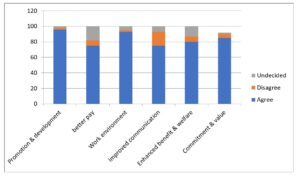
Furthermore, while an ideal CMP has its objectives of which employees’ job satisfaction is prime, job satisfaction on the other hand also has parameters driving it, of which CMP is paramount. Finding from the test of hypothesis 3 through chi square confirms that the State Civil Service CMP impact positively on the parameters that induces local government Lagos employees’ job satisfaction. In addition, based on the parameters, 96% agrees it facilitates promotion and self-development satisfaction, 76% better pay, 93% work environment, and 76% better organisation communication, while 84% agrees that it facilitates job satisfaction from organisation commitment to employees’ welfare. Influential factors of employees’ job satisfaction according to Wang (2024) are work environment, leadership style, salary and benefits, career development, job experience, and educational level. The findings above indicate positive correlation between these factors and Lagos State Local Government employees’ job satisfaction.
Fig 2: Chart illustrating the responses in percentages on impacts of CMP on enablement of job satisfaction in Lagos State Local Governments
Similarly, findings from studies on other states in Nigeria corroborate this. The finding of the study of Ngonadi & Nwanodi (2023) on the role of conflict management in organisational performance at the Ministry of Works in Anambra State confirms a significant positive relationship between effective conflict management and improved organisational performance, and proper collaboration is significantly boosting employee productivity. A survey investigation by Agbo (2020) at the Broadcasting Corporation of Abia State reveals a positive and significant link between conflict management and organisational performance, and further, adequately implemented motivational packages enhance workforce productivity. At the University of Calabar Teaching Hospital, Ele et al (2024) find that conflict avoidance positively enhances employee performance, while collaboration significantly impacts commitment to achieving organisational goals, conflict accommodation improves employee motivation, and mediation fosters greater involvement.
Effectiveness of the strategies is central to the outcomes, hence organisation policy must choose right. Assessing the impacts of some of the strategies on the 265 samples of the civil servants in Enugu State, with Pearson correlation analysis Ozougwu et al (2024) indicate that the avoidance strategy significantly improves employee output, while the compromise strategy positively enhances clientele satisfaction. Similarly, Ulker & Timuroglu (2024) maintain that specifically, constructive, accommodative, compromise, avoidance, and coercive strategies contribute positively to job satisfaction among employees in the accounting sector. Tumwebaze (2020) examines the effects of the strategies on employee performance at Kampala Capital City Authority (KCCA) and data analysis shows satisfactory correlation between the two, with conflict resolution strategies account for 27.7% of the variation in employee performance, compromise being the strongest predictor, followed by third-party intervention and negotiation as least in that order. Finding from Lekik et al (2019) study on job satisfaction in public sector in Belgrade region using two independent contextual time period shows salary, team work, and steady promotion, remuneration policy, superior-subordinate relationships and nature of the job have direct and positive correlation with total job satisfaction. The paper concludes that employee job satisfaction analysis is a reliable tool to enhance organisational performance and effective allocation of resources.
Impacts of suitable, clear and transparent process are germane to organisation CMP outcomes. It promotes collaboration, fosters innovation, while preventing conflicts from unproductively escalating. Effective conflict management ensures that disagreements are handled productively, minimizing negative impacts and contributing to a healthier, more efficient workplace environment (Ariani, 2024).
Constructive disputes management in organisations can foster a collaborative environment that promotes innovation and job satisfaction. Research indicates that well-implemented conflict management strategies lead to continuous work processes, thereby boosting organisational performance. Thus, effective conflict management enhances morale, performance, and profitability, all of which contribute to organisational performance (Igbokwe, 2024).
Furthermore, regular feedback and timely conflict resolution can improve employee satisfaction and job performance, hence, organisational efficiency is negatively impacted by poor communication or interpersonal skills. Additionally, mismanaged conflicts also negatively affect productivity, employee health, and job satisfaction. Additional information provided by the respondents indicates that the local government employees have not been having major industrial conflict with the state government for over fifteen years, which is an evidence of functional CMP and must be sustained.
Policy Implications
The following are necessary for effective policy decision-making and implementation concerning the conditions of service of employees in Lagos State Public Service:
- Evidence from the study reveals the impacts of participatory and inclusive decision-making. Therefore, government should always adopt it as a policy to involve the beneficiaries in the decision-making process.
- The findings also reveal the impacts of adhering to processes as laid down in various enabling rules and laws. Therefore, government should always emphasize laying down clear and enduring processes in planning and implementing the conditions relating to employees’ consultation and engagement processes.
- Findings also reiterate the importance of transparency and trust in arriving at agreements with labour representatives. Therefore, decision-makers should always be open to all available options in the process of arriving at decisions or solutions to issues bothering on workers’ welfare because of the impacts the trust on decisions will have on the employees’ job satisfaction.
Recommendations
The following suggestions will strengthen the effectiveness of Conflict Management Policy in Lagos State Public Service in general and local governments in particular:
- There must be periodic review of the policies to accommodate new and emerging issues on the workers’ welfare to prevent distracting agitations.
- Government must always be proactive in resolving any disagreement with the workers to prevent low morale and low productivity.
- Government should always invite and consider all suggestions that can produce win-win outcomes at the end.
- Third party should always be given opportunity to intervene for neutrality and confidence building in issues that cannot be internally resolved.
Conclusion
Employers’ main goal is to achieve higher productivity and performance, while employees prefer to deliver based on guaranteed higher job satisfaction. It is usually the view of public servants that governments are always insincere about the welfare of employees. Hence, it is essential to have a stand-by policy to drive the prevention and resolution of industrial disagreements.
Findings of this research show that Lagos State has a conflict management policy to manage its employees’ conditions of service; that the policy is suitable for engagement, the processes contained in the policy are highly effective, and that it achieves its ultimate goal, which is higher employees’ job satisfaction. Therefore, the implementation of the recommendations will strongly enhance the continuity of industrial harmony between the government and the local government workers in Lagos State.
References:
- Aderogba A.A. (2022). Centrality of Public Policy in Public Governance in Nigeria. (EJMSS) Journal of Management and Security Studies, 2(2), July-October, 2022. A Journal Publication of the Faculty of Social Sciences ESCAE University (Avotrou) Cotonou, Republic of Benin. https://escaebeninuniversiyu.com/journal/#
- Aderogba, A.A. &Aderogba, O. (2022): Regionalizing Africa Development Administration through New Partnership for Africa’s Development (NEPAD): Any Effect on the Nigeria’s Human Resource Development? Humanities, Management, Arts, Education & the Social Sciences Journal. 1 0 . No. 3, Pp 87-98. Available online at www.isteams.net/humanitiesjournal
- Aderogba, A. A. &Aderogba O.A. (2023). Functional Local Government Autonomy in Nigeria: Thesis for a Community Participation Model. Shodh-sari – An international multidisciplinary journal of International Council for Education Research and Training, India (ICERT) 2(2), 300-318.https://doi.org/10.59231/SARI7588.
- Agbo, M. (2020). Effects of conflict management on organizational performance (A study of broadcasting corporation of Abia State).Journal of Humanities and Social Science (JUST), 20(6), 312-329.
- Ali, W. (2016). understanding the concept of job satisfaction, measurements, theories and its significance in the recent organizational environment: A theoretical framework. Archives of Business Research, 4(1).https://doi.org/10.14738/abr.41.1735.
- Ariani, F. (2024). The role of conflict management in resolving conflicts in organizations. TransformaJurnalManajemenManajemen, 2(1), 1-5. 10.56457/tjm.v2i1.99
- https://www.online.auckland.ac.nz/2022/04/11/perspectives-in-public-policy-the-policy-cycle
- Baxi, B. &Atre, D. (2024). Job satisfaction: Understanding the meaning, importance, and dimensions. Journal of Management and Entrepreneurship Research, 18, 34-40.
- Bies, R. J. &Moag, J. S. (1986). Interactional justice: Communication criteria of fairness. In R. J. Lewicki, B. H. Sheppard, & M. H. Bazerman (Eds.), Research on negotiation in organizations (pp. 43–55). Greenwich, CT: JAI Press.
- Bodtker, A. M. & Jameson, J. K. (2001). Emotion in conflict formation and its transformation: Application to organizational conflict management. International Journal of Conflict Management, 12(3), 259-275.
- Cropanzano, R. & Molina, A. (2015). Organizational justice. In James D. Wright (ed.), International Encyclopedia of the Social & Behavioral Sciences, (2nd ed), 17, 379-384. Oxford: Elsevier.
- Deutsch, M. (1976). Equity, equality, and need: What determines which value will be used as the basis of distributive justice? Journal of Social Issues, 31(3), 137-149.
- DeChurch, L. A., Mesmer-Magnus, J. R. & Doty, D. (2013). Moving beyond relationship and task conflict: Toward a process-state perspective. Journal of Applied Psychology, 98(4), 559-578.
- De Dreu, C. K., &Beersma, B. (2005). Conflict in organizations: Beyond effectiveness and performance. European Journal of Work and Organizational Psychology, 14(2), 105-117.
- Ele A. A., Ekpenyong B. O., Okongo N. J., Eneh S. I., Arikpo N. N. (2024). Effects of conflict management strategies on employees’ performance in the University of Calabar Teaching Hospital, Calabar, Nigeria.African Journal of Social Sciences and Humanities Research, 7(2), 121-136. DOI: 10.52589/AJSSHRLGN8RDEL.
- Emiola, A. (2008). Nigerian Labour Law (4th) Ogbomoso: Emiola Publishers.
- Igboeche, P.O.I. (2015). Analysis of conflict management and resolution in nigerian public service. https://www.ajol.info>article>view.
- First Tee (2017). Resolving conflict in 4 steps.https://firsttee.org/2017/03/13/resolving-conflict-4-steps/
- Greenberg, J. (1993). The social side of fairness: Interpersonal and informational classes of organizational justice. In R. Cropanzano (Ed.), Justice in the workplace: Approaching fairness in human resource management (pp. 79–103). Hillsdale, NJ: Erlbaum.
- Hackman, J. R., & Oldham, G. R. (1976). Motivation through the design of work: Test of a theory. Organizational Behavior and Human Performance, 16(2), 250-279.
- Herzberg, F., Mausner, B., &Snyderman, B. B. (1959). The motivation to work. New York: John Wiley & Sons.
- Igbokwe, P. I. (2024). Conflict management and organizational performance.Global Research Review in Business and Economics, 10(2), 54-61. 10.56805/grrbe.24.10.2.27.
- Jehn, K. A. (1995). A multi-method examination of the benefits and detriments of intragroup conflict.Administrative Science Quarterly, 40(2), 256-282.
- Judge, T. A., Thoresen, C. J., Bono, J. E., & Patton, G. K. (2001). The job satisfaction–job performance relationship: A qualitative and quantitative review. Psychological Bulletin, 127(3), 376-407.
- Lagos State Government Public Service Rules, (2015).
- Lekić, N. ,Vapa-Tankosić ,J., Rajaković-Mijailović, J., Lekić, S. (2019). An analysis of factors influencing employee job satisfaction in a public sector.Business Administration and Management, 3(XXII). DOI: 10.15240/tul/001/2019-3-006.
- Lipsky, D. B., Seeber, R. L., & Fincher, R. D. (2020). Emerging systems for managing workplace conflict: Lessons from American corporations for managers and dispute resolution professionals. San Francisco: Jossey-Bass.
- Longe , O.O (2019). Labour law: Principles and practice. Lagos: Jimsalam Ltd.
- McGinley, J. (2017). Conflict Management Policy. NHS Dumfries & Galloway.
- Mohammed, T. (2017). Organizational conflict: A review of the literature. International Journal of Science and Research (IJSR), 6(12), 547-553
- Mullins, J.L. (2005). Management and organizational behavior (7thed). Pearson Education Limited, Essex, p. 700
- National Industrial Court Act, (2006).
- Neupane, A. (2022). An overview of organizational conflict.Journal of Research in Business and Management, 10(8), 145-149.
- Ngonadi, &Nwonadi, L. (2023). Conflict management in organizational performance in the Anambra State Ministry of Works, Awka.Journal of the Management Sciences, 60(4), 302-322.
- Ozougwu, L. C., Okonkwo, E. &Nnadi, C. S. O. (2024). Conflict management practices and performances of civil servants in Enugu State.Journal of Business Research and Statistics, 6(1), 17-32. https://doi.org/10.5281/zenodo.10702800.
- Rhodes-Vivour, A.O. (2008) Mediation- A face saving device: the Nigerian perspective. Journal of International Bar Association, 8(4), 1-8.
- Robbins, S. P. & Judge, T. A. (2021). Essentials of organizational behavior (15th ed.). Pearson.
- Rooyen, C.V. (2024). Managing conflict in the workplace.Labour Guide.https://labourguide.co.za/general/managing-conflict-in-the-workplace
- Spector, P.E. (1997). Job satisfaction: Application, assessment, causes and consequences. Thousand Oaks, CA: Sage Publications, Inc.
- Thibaut, J. & Walker, L. (1975). Procedural Justice: A psychological analysis. Hillsdale, NJ: Erlbaum.
- Tjosvold, D. (2008). The conflict-positive organization: It depends upon us. Journal of Organizational Behavior, 29(1), 19-28.
- Trade Dispute Act, Cap T14, (2004).
- Trade Dispute Decree, No. 7, (1976).
- Tumwebaze, E., Wandiba, A. &Osunsan, O. (2020). The effect of conflict resolution strategies on employee performance in Kampala Capital City Authority (KCCA), Uganda.International Journal of Social Sciences and Information Technology, V(II), 9-21.
- Tyler, T.R. (2000). Social justice: Outcome and procedure. International Journal of Psychology, 35, 117–125.
- Ülker, Dilan&Timuroglu, Muhammed. (2024). The effect of conflict management strategies on job satisfaction: A study in the accounting sector. AnadoluÜniversitesiSosyalBilimlerDergisi, 24(3), 871-896. 24. 871-896. 10.18037/ausbd.1340285.
- Wang, Y. (2024). Factors affecting employees’ job satisfaction: Organizational and individual levels. SHS Web of Conferences 181, 01037, 1-5. https://doi.org/10.1051/shsconf/202418101037
- Wiseman, J.; Stillwell, A. (2022). Organizational justice: Typology, antecedents and consequences. Encyclopedia, 2, 1287–1295. https://doi.org/10.3390/encyclopedia2030086.
- Yean, T. &Yusof, A. (2016). Organizational justice: A conceptual discussion. Procedia – Social and Behavioral Sciences, 219, 798-803. https://doi.org/10.1016/j.sbspro.2016.05.082.
- Kumar, S. (2024). Patience catalyst for personal transformation. Eduphoria-An International Multidisciplinary Magazine, 02(2), 77–80. https://doi.org/10.59231/eduphoria/230408
- Kumar, S. (2024). The Relationship between Cognitive Behavior therapy (CBT) and Depression Treatment Outcomes: A review of literature. Eduphoria-An International Multidisciplinary Magazine, 02(3), 20–26. https://doi.org/10.59231/EDUPHORIA/230410
Statements & Declarations:
Peer-Review Method: This article underwent double-blind peer review by two external reviewers.
Competing Interests: The author/s declare no competing interests.
Funding: This research received no external funding.
Data Availability: Data are available from the corresponding author on reasonable request.
Licence: Effects of Civil Service Conflict Management1 Policy (CMP) On Local Government Employees’ Job Satisfaction in Lagos State, Nigeria © 2025 by A. Aderogba Ademola, A. Ayodele John, A. Aderogba Opeyemi & O. Ajani Akeem is licensed under CC BY-NC-ND 4.0. Published by ShodhManjusha.
Ethical Statement: This study involved human participants. All procedures were conducted in accordance with ethical standards of research involving human subjects. Informed consent was obtained from all participants before data collection. Participation was voluntary, anonymity and confidentiality of respondents were ensured, and no personally identifiable information was collected.